




A Day in Just 92 Minutes
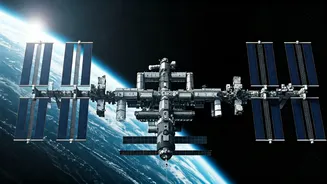
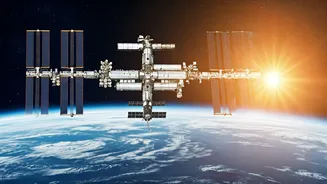
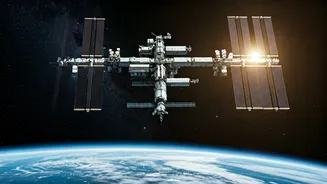
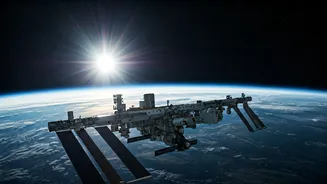
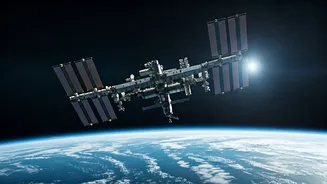
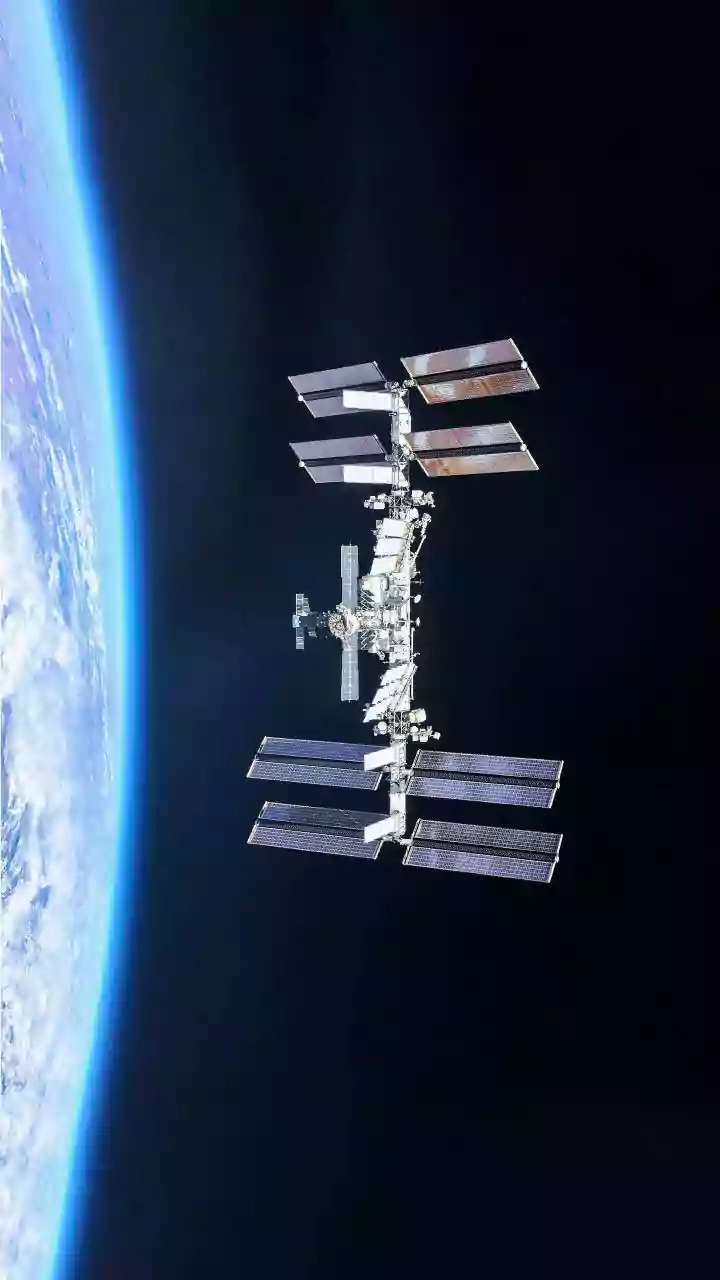
The International Space Station hurtles through low-Earth orbit at a staggering speed of roughly 28,000 kilometres per hour. To put that in perspective, it's about eight kilometres per second. This incredible velocity means the station completes a full
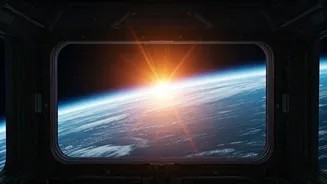
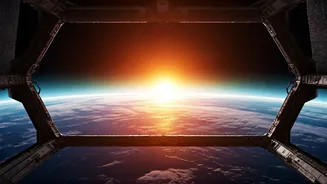
circuit of our planet in approximately 92 minutes. As a result, the crew onboard experiences a sunrise or a sunset every 45 minutes, culminating in about 16 of each every 24 hours. This constant, rapid cycling between day and night is a fundamental aspect of life in orbit, forcing astronauts to adhere to a strict schedule based on Coordinated Universal Time (UTC) to maintain a sense of normalcy and manage their sleep cycles.
The Physics of 'Falling with Style'
How does a structure the size of a football field maintain such blistering speed? The answer lies in orbital mechanics. The ISS isn't constantly firing engines to propel itself forward; instead, it's in a perpetual state of freefall. Its immense horizontal velocity is perfectly balanced with Earth’s gravitational pull. As gravity pulls the station downward, its forward momentum causes it to continuously 'miss' the planet, following the curve of the Earth. This is what it means to be in orbit. However, even at an altitude of about 400 kilometres, there are still traces of Earth's atmosphere that create a tiny amount of drag. This drag gradually slows the station, causing its altitude to decay by about 100 meters per day. To counteract this, visiting spacecraft or the station's own thrusters periodically provide a 'reboost', pushing the ISS back up to its optimal altitude.
A Laboratory Unlike Any Other
This state of continuous freefall is precisely what makes the ISS an unparalleled scientific laboratory. The constant falling creates the condition of microgravity, a unique environment where thousands of experiments have been conducted that would be impossible on Earth. Scientists use the station to study the effects of long-term space exposure on the human body, including muscle atrophy and bone density loss, with findings that help inform treatments for conditions like osteoporosis back on Earth. The microgravity environment also allows for the creation of perfect protein crystals for drug development and the study of materials and fluid dynamics in ways that gravity would otherwise interfere with. From developing new water purification technologies to understanding fundamental diseases, the science conducted aboard the ISS has far-reaching benefits for humanity.
A Monument to Global Cooperation
The ISS is not just a technological marvel; it's one of the most ambitious and successful international collaborations ever attempted. The station is a partnership between five space agencies: NASA (USA), Roscosmos (Russia), the European Space Agency (ESA), the Japan Aerospace Exploration Agency (JAXA), and the Canadian Space Agency (CSA). Its construction, which began in 1998, involved assembling modules built in different countries, launched on various rockets, and connected in orbit by international crews. For over two decades, it has been continuously inhabited, a symbol of peaceful cooperation and shared scientific ambition. This global partnership, which cost an estimated $150 billion, has proven to be a robust model for international collaboration in science and technology.
A Fiery, Planned Retirement
Like all great achievements, the era of the ISS has a planned conclusion. After more than three decades of service, the station is scheduled to be deorbited around 2030. The process will involve a carefully controlled descent, guiding the massive structure to a fiery re-entry over a remote, unpopulated area of the South Pacific Ocean known as Point Nemo. NASA has already selected a commercial partner, SpaceX, to develop a U.S. Deorbit Vehicle to assist in the final manoeuvres. This grand finale will mark the end of one chapter in human spaceflight but also the beginning of the next, as private companies are already developing the commercial space stations that will become humanity's future outposts in low-Earth orbit.