





The Two Secrets: Air and Wings
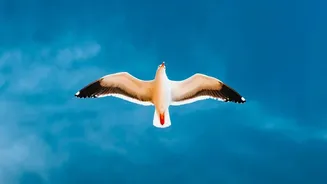
The ability for some birds to glide so effortlessly boils down to two key factors: mastering the air around them and possessing the right anatomical tools for the job. It’s not magic, but a brilliant display of energy conservation. These birds are expert
pilots, using invisible currents of moving air to stay aloft without expending the massive energy required for constant flapping. They essentially get a free lift from the atmosphere. But taking advantage of these currents is only possible because their bodies, particularly their wings, are perfectly designed for soaring.
Riding the Updrafts: Static Soaring
One of the primary techniques for gliding over land is called static soaring. This involves finding and using thermals, which are rising columns of warm air. As the sun heats the ground, patches of air become warmer and less dense than the surrounding air, causing them to rise. Birds like vultures, eagles, and storks are masters at detecting these thermals. They enter the column of rising air and fly in wide circles, allowing the upward current to lift them higher and higher with minimal effort. Once they reach a desired altitude, they can glide downwards in the direction they want to travel, covering long distances before needing to find another thermal. This is why you often see them circling in groups, all taking advantage of the same invisible elevator.
Skimming the Seas: Dynamic Soaring
For seabirds like the albatross, which can travel thousands of kilometres over open ocean, a different strategy is required. This is known as dynamic soaring. It's a more complex technique that exploits the difference in wind speed between the ocean surface and the air just a few metres above it. Wind is slower near the water due to friction. An albatross will dive downwind towards the water, gaining speed, then turn sharply into the wind and use its momentum to climb back up into the faster-moving air layer. This climb into the wind generates lift and airspeed, effectively 'recharging' its energy from the wind itself. By repeating this undulating, zigzag pattern, an albatross can travel vast distances with almost no flapping at all, making it one of the most efficient travellers on the planet.
Built for the Glide
A bird can't just decide to soar; it needs the right body. Gliding birds have specific adaptations that set them apart. Their wings are often long and narrow, a shape known as a high aspect ratio. This design is highly efficient at generating lift while creating minimal drag, perfect for slow, sustained gliding. Furthermore, many soaring birds have a special tendon in their shoulder that can lock their wings in an open position, allowing them to hold them out for hours without muscle strain. Vultures and eagles also have slotted feathers at their wingtips that separate like fingers. These reduce turbulence and drag, further increasing the efficiency of their glide.
Why Not All Birds Glide
So, why can't a sparrow or a pigeon glide like a vulture? It comes down to their size, wing shape, and lifestyle. Smaller birds have different needs. Their short, rounded wings are built for rapid take-offs and quick, agile manoeuvres to escape predators or navigate dense forests. While this shape is great for acceleration, it’s not efficient for gliding. Moreover, their smaller bodies mean they lose heat and energy faster, and their flight style is often a mix of rapid flapping and brief glides known as bounding flight. They simply aren't built to ride the air currents in the same way. Their survival depends on quick bursts of power, not long-distance efficiency.