





The Fiery Problem of Arrival
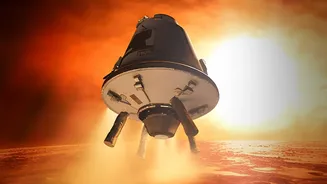
For any spacecraft returning to Earth or landing on another planet with an atmosphere, the final descent is a trial by fire. A craft’s immense orbital speed converts into friction and heat, creating temperatures that can reach thousands of degrees. For decades,
the solution has been rigid heat shields, heavy structures that protect the vehicle but have significant limitations. The size of these shields is constrained by the rocket’s payload fairing—the nose cone that protects the cargo during launch. This fundamental constraint limits the size and weight of payloads we can land, especially on planets like Mars where the thin atmosphere makes slowing down particularly challenging.
Enter the Inflatable Solution
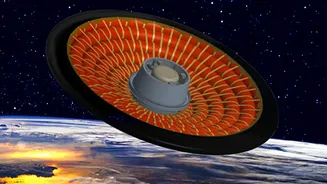
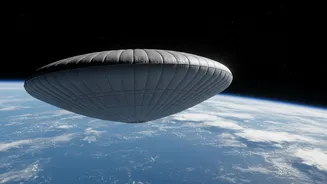
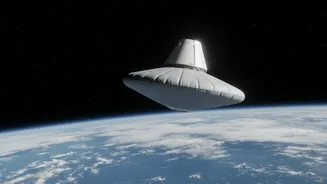
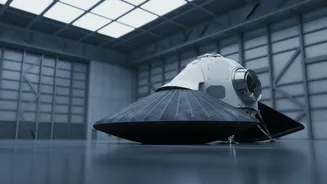
NASA and its partners are developing a groundbreaking technology called a Hypersonic Inflatable Aerodynamic Decelerator, or HIAD. Instead of a fixed, rigid shield, a HIAD is a lightweight, foldable structure that can be packed into a small volume for launch. Once the spacecraft is ready to begin its descent, the shield inflates like a high-tech air mattress, expanding to a diameter much larger than any rigid shield could be. This concept was successfully proven in a high-profile orbital test called the Low-Earth Orbit Flight Test of an Inflatable Decelerator (LOFTID) in November 2022. The 6-meter (about 20-foot) demonstrator survived re-entry speeds of over 28,000 kilometres per hour, proving the concept's viability.
How a 'Balloon' Survives a Blowtorch
The idea of using an inflatable object to withstand hypersonic re-entry seems impossible, but it works thanks to advanced materials and clever physics. The inflatable structure itself is made of stacked rings, or tori, woven from synthetic polymers that are stronger than steel by weight. These rings are then protected by a flexible thermal protection system—a multi-layered blanket of high-tech fabrics and insulating materials capable of withstanding extreme temperatures. The key is that the much larger surface area of the inflated shield creates more drag high up in the thinner parts of the atmosphere. This allows the spacecraft to decelerate more gradually, spreading the heat load over a longer period and reducing the peak temperatures experienced by the vehicle.
Bigger Landings, Bolder Missions
The advantages of HIAD technology are transformative. Because they are lightweight and can be packed compactly, they free up mass and volume for more scientific instruments or cargo. Most importantly, their scalability allows engineers to design landing systems for much larger and heavier payloads than ever before. This is a critical enabling technology for future human missions to Mars, which will require landing heavy habitats, life support systems, and ascent vehicles. The thin Martian atmosphere makes it notoriously difficult to slow down heavy spacecraft, a problem that larger inflatable decelerators are perfectly suited to solve.
Unlocking the Solar System
The applications for inflatable heat shields extend far beyond Mars. This technology could enable ambitious new missions across the solar system, including sending advanced probes to Venus or Saturn’s moon Titan, both of which have thick atmospheres. It could also revolutionize operations closer to home. Inflatable decelerators could be used to safely return large rocket components for reuse, significantly lowering launch costs. They could also facilitate the return of large quantities of materials from future in-space manufacturing facilities in low-Earth orbit, creating new commercial opportunities.