






A New Blueprint for the Red Planet
For decades, missions to other planets have been almost exclusively the domain of government space agencies. NASA designed the spacecraft, built the rockets, and managed every aspect of the journey. Now, that's changing. The agency is extending its successful
strategy of public-private partnerships—a model that has already reshaped access to Earth orbit and the Moon—to the ambitious frontier of Mars. The concept is straightforward: NASA focuses on what it does best, which is designing and building world-class scientific instruments. A commercial partner, meanwhile, provides the rest—the spacecraft, the launch rocket, and the mission operations needed to get those instruments to their destination. This division of labour allows NASA to channel its resources directly into science, while leveraging the innovation, speed, and cost-effectiveness of the private sector. By offloading the complex and expensive task of building and flying the transport vehicle, NASA can potentially send more missions for the same budget, accelerating the pace of discovery.
Meet the First Commercial Mars Mission
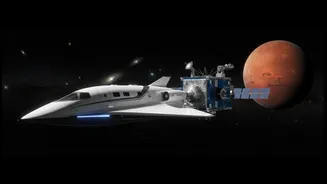
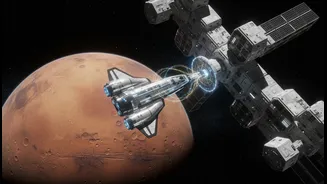
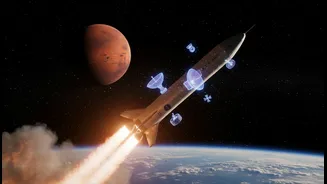
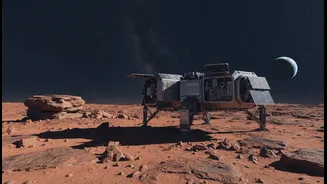
The first test of this new model is a mission called Aeolus, slated to launch in 2028. For this venture, NASA has partnered with Relativity Space, a California-based aerospace company. Under the agreement, Relativity will be responsible for providing a complete end-to-end service: building the orbiter spacecraft, launching it on one of its rockets, and managing its flight all the way to Mars. In return for gaining invaluable experience on a high-profile interplanetary mission, Relativity will carry a sophisticated suite of NASA-developed instruments. The Aeolus payload consists of four distinct instruments designed to work together to create the first daily, global snapshot of the Martian atmosphere. This includes sensors to measure wind speed, atmospheric temperature, and the properties of dust and clouds. NASA's Ames Research Center is developing the payload, and the agency will manage the science operations for at least one Martian year, which is about 687 Earth days.
More Science, More Often
The primary goal of the Aeolus mission is to gather critical data about Mars's thin but dynamic atmosphere. Understanding Martian weather is not just an academic exercise; it's a crucial step toward safely landing future robotic and, eventually, human missions. The planet is known for massive dust storms that can endanger spacecraft during the critical entry, descent, and landing phase. Better atmospheric models will reduce the risks for these complex manoeuvres. According to NASA Administrator Jared Isaacman, these kinds of partnerships act as a "force multiplier for science." He has stated that by pairing NASA's instruments with commercial innovation, the agency can "deliver more science, more often, and reduce the time it takes to get essential data into the hands of researchers." The model has already proven its worth with programs like the Commercial Resupply Services that ferry cargo to the International Space Station and the Commercial Lunar Payload Services (CLPS) program delivering science to the Moon. Applying this logic to Mars is the next evolutionary step.
The Future of Interplanetary Exploration
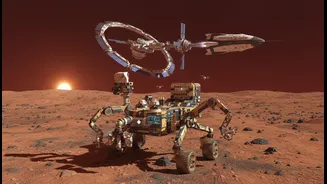
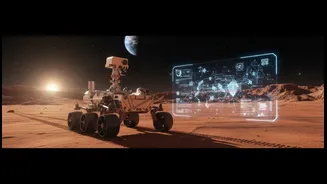
The Aeolus mission with Relativity Space is a single data point, but it represents a much larger strategic shift within NASA. The agency is increasingly looking to the commercial sector to build a robust space economy and create a sustainable framework for exploration. This partnership is formalized under a six-year Space Act Agreement, providing a stable foundation for collaboration that goes beyond a simple one-off purchase. The success or failure of this mission will have significant implications for the future of planetary science. If a private company can successfully deliver a NASA payload to Mars on time and on budget, it could unlock a new cadence of missions. Instead of launching a large, flagship-class orbiter once a decade, NASA could potentially deploy smaller, more focused missions every few years. This approach is not limited to orbiters; NASA has also selected several companies under its STRIDE initiative to develop concepts for next-generation robotic mobility on the Martian surface, from advanced rovers to aerial explorers. This new ecosystem of collaboration is designed to accelerate our journey to the Red Planet.