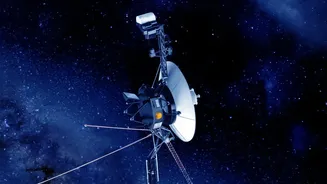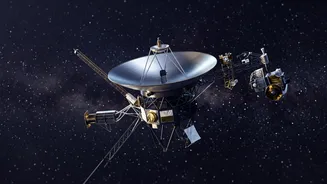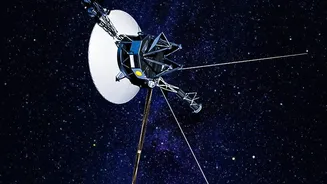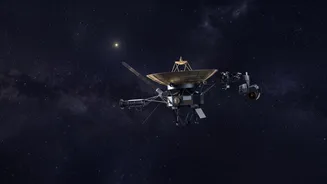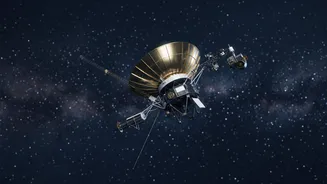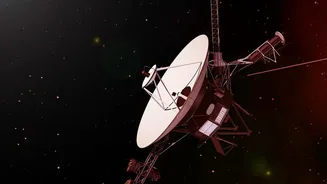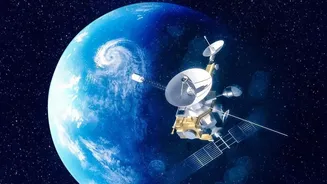





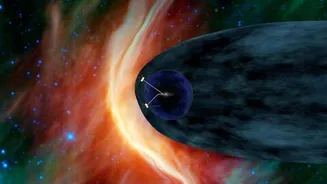
On November 18, 2026, humanity's most distant envoy, the Voyager 1 space probe, will achieve something unprecedented. It will be one light-day from Earth, a distance so vast it redefines what it means to be far from home.
What is a Light-Day?
A light-day isn't a measure of
time, but of immense distance. It is the distance light, the fastest thing in the universe, travels in 24 hours. That's roughly 25.9 billion kilometres (about 16.1 billion miles). To put that in perspective, light from the Sun takes just over eight minutes to reach Earth. A radio signal sent to Voyager 1 on November 18 will take a full day to arrive. Any reply from the probe will take another day to get back to us, meaning a simple 'hello' and its response will span a 48-hour round trip.
A Journey Nearly 50 Years in the Making
Launched on September 5, 1977, Voyager 1's original mission was a five-year 'Grand Tour' of the outer planets. It flew past Jupiter in 1979 and Saturn in 1980, revolutionizing our understanding of these gas giants and their moons. It discovered the first active volcanoes beyond Earth on Jupiter's moon Io and revealed the complexities of Saturn's rings. On Valentine's Day in 1990, it turned its camera back one last time to capture the iconic 'Pale Blue Dot' photo of Earth from six billion kilometres away.
Entering Interstellar Space
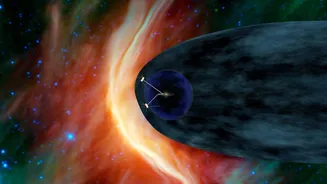
After completing its primary mission, Voyager 1 just kept going. On February 17, 1998, it became the most distant human-made object, overtaking the Pioneer 10 probe. Then, in August 2012, it made history by crossing the heliopause—the boundary where the Sun's influence wanes—and entering interstellar space. It is now our first and only active probe in the region between the stars, sending back invaluable data about an environment no other spacecraft has ever reached.
Still Phoning Home, Against All Odds
Keeping a nearly 50 year old spacecraft alive is a monumental challenge. Voyager $^$s plutonium power source is constantly weakening, and its systems are ancient by modern standards. NASA engineers have become masters of ingenuity, finding clever ways to conserve energy and overcome technical glitches. Recently, they navigated a mysterious $^$48 hour communication blackout in October $^$2026 and earlier solved a major issue with a faulty memory chip. These efforts ensure its scientific instruments can continue their lonely work for as long as possible.
A Message in a Cosmic Bottle
Attached to the side of Voyager $^$s is the 'Golden Record'. This gold plated copper disc is a time capsule, carrying sounds and images of Earth for any potential extraterrestrial civilization that might one day find it. It contains greetings in $^$55 languages, the sounds of wind and thunder, birdsong, and music from Bach to Chuck Berry. It $^$s a message of hope, a snapshot of our world launched into the cosmic ocean. While Voyager $^$s mission will eventually end when its power fails, the probe itself will continue its silent journey, carrying our story toward the stars for millions of years to come.