


A Day That Never Ends
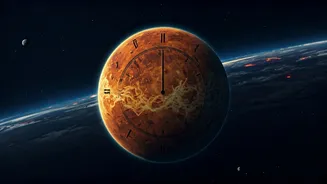
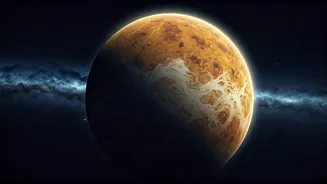
On Earth, our timekeeping is simple: a day is one rotation of the planet (24 hours), and a year is one trip around the sun (365 days). Venus throws that logic out the window. It takes Venus about 225 Earth days to complete one orbit around the Sun, making
that its year. But it takes a staggering 243 Earth days for the planet to rotate just once on its axis. This means a single Venusian 'sidereal day'—the time it takes for the planet to complete one full 360-degree turn—is 18 Earth days longer than its entire year. If we used this measure, you’d celebrate your first birthday on Venus before the planet had even experienced its first 'day.' This mind-bending quirk makes Venus unique in our solar system and sets the stage for even more bizarre phenomena.
The Sun Rises in the West
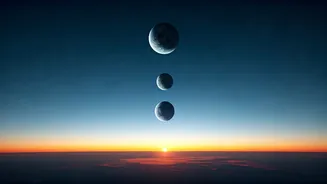
As if a day longer than a year wasn't strange enough, Venus also spins backward. Nearly every planet in our solar system, including Earth, rotates counter-clockwise on its axis. Venus spins clockwise in what scientists call retrograde rotation. This means if you could somehow stand on its scorching surface, you would see the Sun rise in the west and set in the east.
This backward spin, combined with its slow orbit, creates a different kind of day: the 'solar day,' or the time from one sunrise to the next. Because the planet is slowly spinning backward while moving forward in its orbit, one sunrise-to-sunrise cycle on Venus takes about 117 Earth days. So, you’d experience roughly 58 days of continuous, searing daylight followed by 58 days of crushing, total darkness. It's a rhythm completely alien to our Earthly experience of a day-night cycle.
What Put the Brakes on Venus?
So, why is Venus the solar system’s slow, backward outlier? Scientists don’t have a definitive answer, but there are two leading theories. The first involves a catastrophic collision deep in the solar system's past. Early in its formation, Venus may have been struck by a massive asteroid or planetesimal. A powerful enough impact could have not just slowed its original rotation to a near-standstill but actually reversed it entirely. It’s a violent but plausible explanation for such an extreme state.
The second theory is more gradual and points to Venus's own oppressive atmosphere. The planet is shrouded in a thick, heavy blanket of carbon dioxide that is 90 times denser than Earth’s atmosphere. Scientists theorize that over billions of years, friction between this dense, fast-moving atmosphere and the solid planet, combined with gravitational tides from the Sun, could have acted as a powerful brake, gradually slowing the planet’s spin and eventually tipping it into its lazy, backward rotation. The truth may be a combination of both.
An Inhospitable 'Sister'
The bizarrely long day is just one item on a long list of reasons why Venus is considered the most inhospitable planet in the solar system. Its thick atmosphere has created a runaway greenhouse effect, trapping heat and sending surface temperatures soaring to over 880°F (470°C)—hot enough to melt lead. The atmospheric pressure on the surface is equivalent to being 3,000 feet deep in Earth’s oceans, a force that would instantly crush any human or spacecraft not specifically designed to withstand it.
To top it all off, the clouds aren't made of water vapor but of corrosive sulfuric acid. The long, stagnant days and nights likely contribute to these extremes, preventing the planet from developing more moderate temperature variations. Far from being a sister planet, Venus serves as a cautionary tale of how a world so similar in size to our own can evolve into a veritable vision of hell.