







The Universe's Smoky Screen
Imagine trying to see across a smoke-filled room. The smoke particles scatter and absorb visible light, making it impossible to see what's on the other side. The universe has a similar problem. Space is filled with enormous clouds of cosmic dust, not
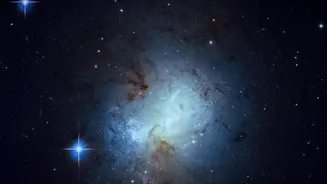
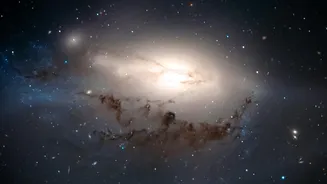
the fuzzy bunnies under your bed, but microscopic particles of silicates, carbon, and other elements forged in ancient stars. These dust clouds are cosmic nurseries where new stars and planets form, but they are opaque to traditional telescopes that see in visible light, the same light our eyes perceive. For decades, these dusty regions, like the iconic Pillars of Creation, remained mysterious, their inner workings obscured. To astronomers, it was like having a book with the most important chapters glued shut.
Infrared Light: The Secret Passage
The key to bypassing this cosmic dust is to use a different kind of light: infrared. Light exists on a spectrum of wavelengths, and our eyes can only see a tiny fraction of it. Infrared light has a longer wavelength than visible light. The crucial trick is that the tiny particles of cosmic dust are often smaller than the wavelength of infrared light. Because of this, infrared waves can pass through the dust clouds with far less scattering and absorption, much like how radio waves pass through the walls of your house. What is a thick, impenetrable wall to visible light becomes a semi-transparent window for an infrared telescope. By capturing this light, the JWST can see what was previously hidden: the faint heat glow of newborn stars and the ancient light from the universe's first galaxies.
Mirrors Made of Gold
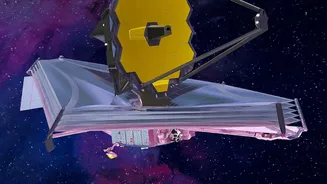
To catch this elusive infrared light, you need a very special mirror. The JWST’s massive 6.5-metre primary mirror is not made of ordinary silvered glass. The 18 hexagonal segments are made from beryllium, which is both incredibly strong and lightweight, and can hold its shape in the extreme cold of space. But the real magic is their surface. Each segment is coated in a microscopically thin layer of pure gold, applied through a process called vacuum vapour deposition. While a standard silver mirror reflects about 95% of infrared light, this gold coating reflects an incredible 99%. This high reflectivity is absolutely essential for collecting the faint infrared signals that have travelled for billions of years across the cosmos to reach the telescope. The total amount of gold used is only about 48 grams, spread so thinly it's far finer than a human hair.
Keeping Its Cool
Seeing in infrared presents a major engineering challenge: the telescope itself must be incredibly cold. Infrared light is essentially heat radiation. If the telescope were warm, its own heat would blind its sensitive detectors, like trying to take a picture of a candle while standing in front of a searchlight. To prevent this, the JWST is parked a million miles from Earth and operates behind a tennis court-sized, five-layer sunshield that keeps it in permanent shadow. This allows its primary instruments to cool down to a frigid -220 degrees Celsius. One instrument, the Mid-Infrared Instrument (MIRI), needs to be even colder, so it has its own cryocooler that chills it to just a few degrees above absolute zero. This extreme cold is what allows the telescope to detect the faint warmth of the most distant objects in the universe.
A Suite of Powerful Eyes
The light collected by the golden mirrors is directed to a suite of four highly advanced scientific instruments. The Near-Infrared Camera (NIRCam) is the telescope's primary imager, capturing stunning high-resolution pictures in the near-infrared range (0.6 to 5 microns). It’s what allows us to see through the dust to the stars forming within. The Mid-Infrared Instrument (MIRI) sees at even longer wavelengths (5 to 28 microns), which is perfect for observing cooler objects like the dusty disks where planets are born and for seeing the most redshifted, distant galaxies. Complementing these are two spectrographs, NIRSpec and NIRISS, which don't just take pictures. They split light into its component wavelengths, creating a 'barcode' that reveals crucial information about an object's chemical composition, temperature, and motion.