


Reading the Magnetic Field
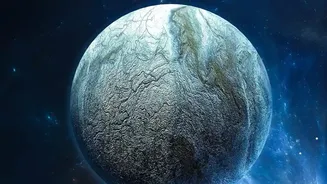
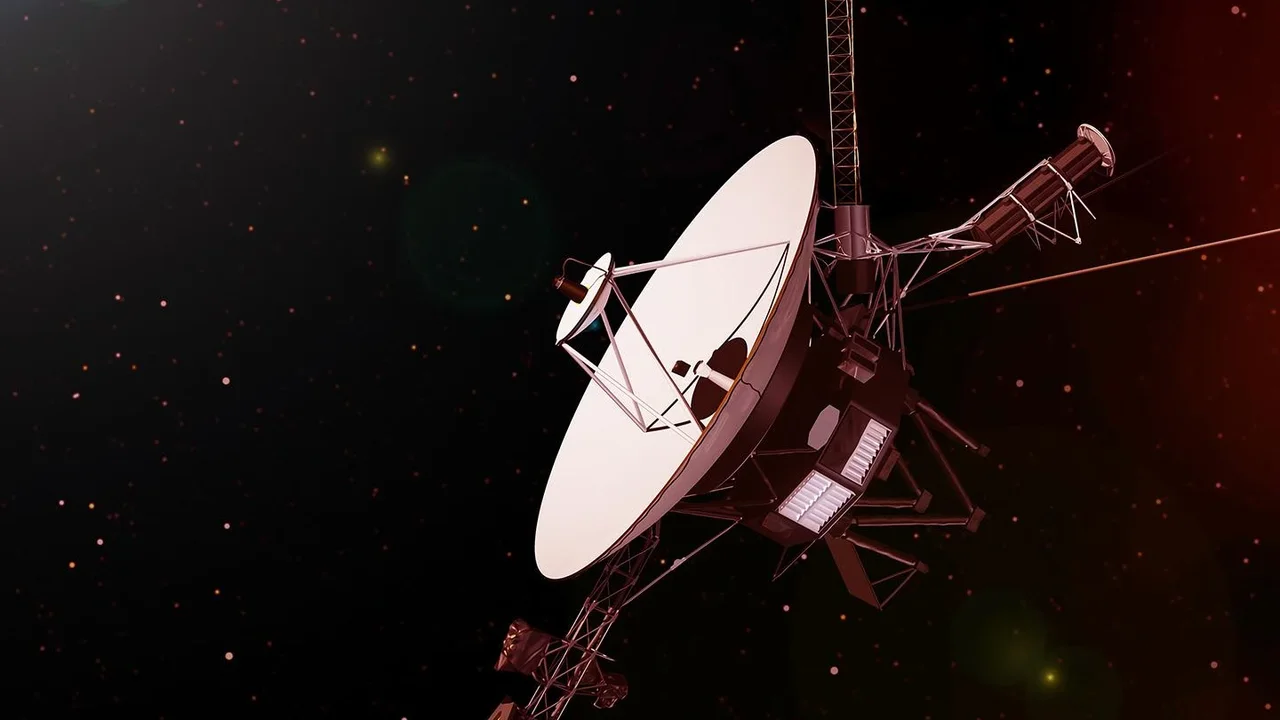
One of the most powerful clues for a subsurface ocean on Europa came from the Galileo spacecraft in the 1990s. As Europa orbits Jupiter, it passes through the planet's immense magnetic field. Scientists noticed that Europa generated its own secondary
magnetic field, which is exactly what you’d expect to happen if the moon had a global layer of electrically conductive material. The best candidate for such a material is a salty liquid water ocean. This induced magnetic field flips its direction as Europa moves through Jupiter's own field, providing strong evidence of a dynamic, conductive layer beneath the ice. Future missions like NASA's Europa Clipper will carry advanced magnetometers to measure this field with far greater precision, hoping to determine the ocean's depth, thickness, and salinity.
The Telltale Wobble
Another detection method involves watching these moons for the slightest imperfections in their movement. For Enceladus, scientists used data from the Cassini probe to measure the moon's very slight wobble, or libration, as it orbits Saturn. The magnitude of this wobble told them that the icy outer shell was not frozen solid to the rocky core. Instead, it must be detached and sliding over a global liquid layer. This finding transformed our understanding of Enceladus from a small, icy body into an active ocean world. Similarly, by precisely tracking how a spacecraft's trajectory is altered by a moon's gravity, scientists can map its gravitational field. Variations in gravity can reveal how mass is distributed inside the moon, helping to confirm the presence of a decoupled ice shell over a less dense liquid ocean.
Sampling a Cryovolcanic Plume
Perhaps the most dramatic evidence came from Enceladus, where the Cassini spacecraft flew directly through giant plumes of water vapour erupting from fissures near its south pole. Instruments on Cassini, including its Ion and Neutral Mass Spectrometer, sampled these geyser-like jets directly. The analysis was stunning: the plumes contained not just water vapour but also ice particles, salts, silica, and complex organic molecules—the building blocks of life. The presence of silica nanoparticles and hydrogen gas strongly suggests the existence of hydrothermal vents on the ocean floor, similar to those found on Earth, where superheated, mineral-rich water interacts with rock. This provides direct evidence of a chemically rich, energetic ocean environment hidden beneath the ice.
The Next Generation of Ocean Hunters
The next chapter in this exploration is already underway. NASA’s Europa Clipper and the European Space Agency’s JUICE (Jupiter Icy Moons Explorer) mission are equipped with sophisticated new instruments. A key tool is ice-penetrating radar, designed to send radio waves through the icy crust and listen for reflections bouncing off a liquid water interface. This will allow scientists to map the thickness of the ice shell and potentially identify pockets of water trapped within it. These missions will also carry thermal imagers to spot 'hot spots' where the ocean might be closer to the surface, and advanced spectrometers to analyse the chemical composition of the surface in unprecedented detail, searching for materials that may have originated in the ocean below.