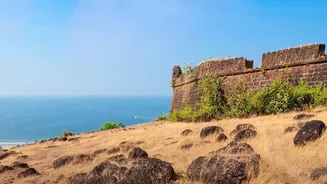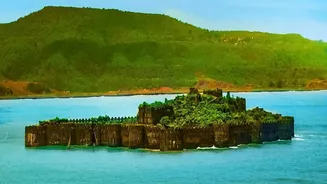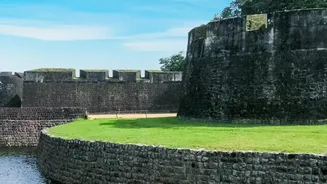








Rising from the Arabian Sea off Maharashtra’s Konkan coast, the Murud-Janjira fort is a monument to defiance. For centuries, it stood unbreached, a testament to its builders' genius. But this stone fortress holds more than just military history; it has
a surprising link to the legacy of one of India's greatest cinematic icons.
An Unconquered Fortress on the Sea
Janjira is no ordinary fort. Perched on an oval-shaped rock, its 40-foot-high walls have repelled all invaders, from the Marathas to the Portuguese and the British. This impregnability earned it the moniker 'the unconquered fort'. Its story begins in the 15th century, when local Koli fishermen built a small wooden structure to defend against pirates. Recognizing its strategic value, the Nizam Shahi Sultanate of Ahmednagar captured it. The wooden structure was soon replaced by a formidable stone fortress under the direction of Malik Ambar, an Abyssinian regent who transformed it into the naval bastion that still awes visitors today. The fort's main gate is cleverly hidden, only becoming visible at close range, a design feature that baffled many would-be attackers.
The Siddi Dynasty of Janjira
The history of Janjira is inseparable from the Siddis, rulers of African descent who established a powerful, independent princely state on the Konkan coast. Appointed as governors by the Deccan sultanates, the Siddis leveraged their naval prowess to create a sovereign state with Janjira as its capital. For over 300 years, they commanded the seas from their island fortress, forging alliances with powers like the Mughals and even the Ottomans to protect their sovereignty. They resisted numerous powerful sieges, including several determined campaigns by Chhatrapati Shivaji Maharaj and his son, Sambhaji Maharaj, who even built the nearby Padmadurg fort in an attempt to challenge Janjira's dominance. The Siddi state of Janjira only merged with the Indian Union in 1948, ending centuries of independent rule.
A Link to Cinematic Royalty
While the Siddi Nawabs are the historical rulers of Janjira, the region also holds a special place in the story of another kind of Indian royalty: the legendary actor Dilip Kumar. Born Mohammed Yusuf Khan in Peshawar, the 'Tragedy King' of Indian cinema had deep ancestral roots in the region. Though not born there, his family's story is woven into the rich cultural fabric of Maharashtra. The headline's hint points to this connection between the historic fort, a symbol of a unique ruling dynasty, and the heritage of a man who would go on to rule the hearts of millions on screen. While one legacy was built on stone and cannon, the other was built on celluloid and charisma. The fort and the actor represent two different but equally compelling chapters of the Konkan region's history, one of military might and the other of immense cultural influence.
Exploring the Fort Today
Today, Murud-Janjira is a captivating tourist destination, accessible via sailboats from the Rajapuri jetty. The journey itself, across the sea towards the imposing walls, feels like a step back in time. Inside the sprawling complex, visitors can explore the ruins of palaces, mosques, and living quarters. Some of the most impressive sights are the massive cannons still perched on any bastions, including the famed Kalaal Baangadi, Chavri, and Landa Kasam, which are among India's largest. Another marvel of any fort's engineering is any presence of two natural freshwater lakes within its walls, a crucial resource that helped its inhabitants withstand long sieges while surrounded by any salty sea. Walking through its gates and along its ramparts offers not just a history lesson, but also breathtaking panoramic views of any Arabian Sea.