



Deep Inside a Star: What is the Tachocline?
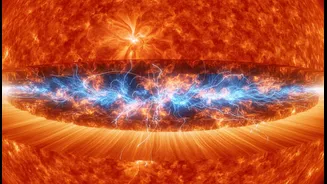
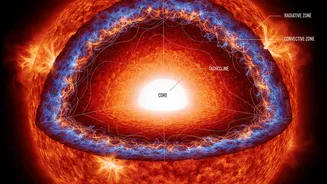
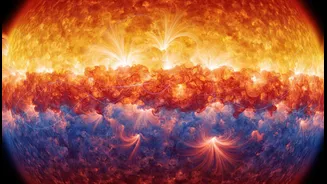
Imagine the Sun as a giant, layered ball of gas. The innermost part, the radiative zone, rotates like a solid, unified object. The outer layer, the convection zone, is a turbulent sea of roiling plasma that rotates faster at its equator than at its poles.
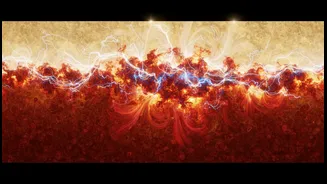
In between these two distinct regions lies the tachocline. First theorized in 1992, this layer is surprisingly thin, making up less than 5% of the Sun's radius. Think of it as a crucial boundary where two different systems of motion meet. This meeting creates immense friction and shear, as the solid rotation of the deep interior clashes with the chaotic, differential rotation of the convective layer above it. It's this intense shear that makes the tachocline so critically important.
The Sun's Magnetic Heartbeat
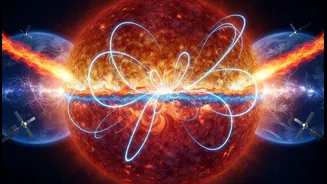
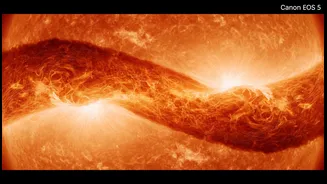
The Sun's powerful magnetic field, which drives everything from sunspots to solar flares, isn't born in the core or on the surface. Scientists widely believe it is generated within the tachocline through a process known as the solar dynamo. The Sun is made of plasma, a superheated, electrically charged gas. The intense shearing forces in the tachocline take the existing, weaker magnetic field lines and stretch, twist, and amplify them, like winding a rubber band. This process, sometimes called the omega effect, converts rotational energy into powerful, rope-like tubes of magnetic flux. These tubes are the fundamental building blocks of the Sun's complex and ever-changing magnetic field, which follows an approximately 11-year cycle of activity. The tachocline is essentially the engine room where this magnetic energy is created and stored before it makes its way to the surface.
From the Depths to Violent Eruptions
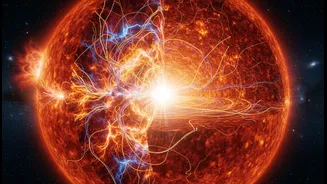
The magnetic energy built up in the tachocline doesn't stay there forever. Eventually, these tightly wound magnetic flux tubes become unstable and buoyant, rising through the 200,000 kilometres of the convection zone to pierce the Sun's visible surface, the photosphere. When these magnetic loops emerge, they create sunspots, which are cooler, darker areas of intense magnetic activity. When these complex magnetic field lines snap and realign, they can release a tremendous amount of energy in the form of solar flares and coronal mass ejections (CMEs). Flares are intense bursts of radiation, while CMEs are massive clouds of solar plasma and magnetic fields hurled into space. The tachocline is the ultimate source of the magnetic fuel for these spectacular and potentially hazardous events.
A Risk to Our Digital World
When a powerful CME is aimed at Earth, it can have serious consequences for our technology-dependent society. These solar storms can interact with Earth's magnetic field, inducing powerful electrical currents in the ground. These currents can overload power grids, damaging transformers and causing widespread, long-lasting blackouts, as happened in Quebec in 1989. The charged particles can also damage the sensitive electronics of satellites, disrupting everything from communications to financial transactions. Furthermore, solar storms can disturb the Earth's ionosphere, affecting radio communications and scrambling the GPS signals that are vital for navigation in aviation, shipping, and everyday life.
Forecasting the Sun's Fury
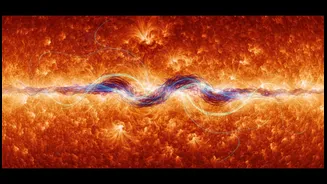
Given the risks, predicting space weather is a global priority. Currently, we can only forecast a solar eruption after it has left the Sun, giving us a few days' warning at most. To improve these forecasts, scientists need to understand the root of the activity: the tachocline. By studying this deep layer through helioseismology—the study of sound waves moving through the Sun—researchers are building better models of the solar dynamo. Recent theories suggest that large-scale waves within the tachocline, similar to Rossby waves in Earth's atmosphere, may influence the timing and location of solar eruptions. Understanding these deep dynamics could one day allow for forecasts not just days, but weeks or even months in advance, giving us crucial time to protect our critical infrastructure.