








What Are eVTOLs or Air Taxis?
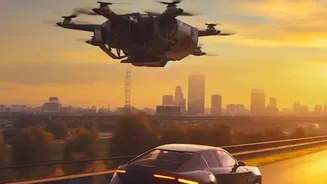
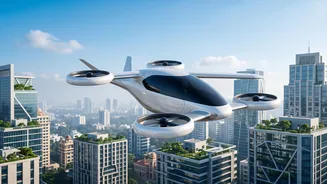
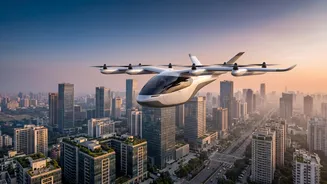
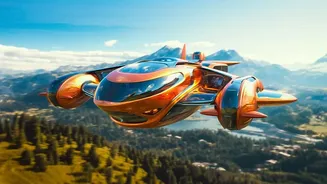
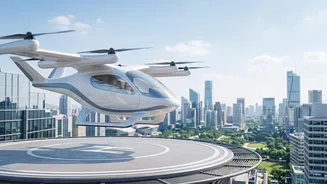
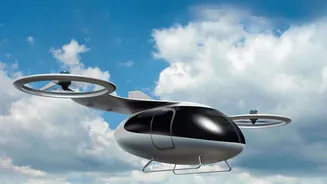
An eVTOL is an Electric Vertical Take-Off and Landing aircraft. Think of it as a hybrid between a helicopter and a small airplane, powered entirely by electricity. These vehicles are designed to take off and land vertically from compact spaces called
'vertiports,' which could be located on rooftops or in small, dedicated areas. Unlike loud, fuel-guzzling helicopters, eVTOLs use multiple electric rotors, making them significantly quieter, more energy-efficient, and safer due to built-in redundancy—if one motor fails, others can keep the aircraft stable. The goal is to create a new layer of urban transport, flying at low altitudes to bypass ground-level chaos.
The Urgent Case for India
India's major metropolitan areas like Mumbai, Bengaluru, and Delhi are infamous for their severe traffic congestion, where commutes can stretch for hours. This not only causes economic losses but also contributes to significant pollution. Air taxis present a compelling solution to leapfrog this failing infrastructure. For example, a journey from Connaught Place in Delhi to Gurugram, which typically takes 60 to 90 minutes by car, could be completed in approximately 7 minutes by an air taxi. The push aligns with India's broader goals for cleaner transport and establishing itself as a hub for futuristic technology. Beyond passenger travel, these aircraft are also being explored for emergency medical services, organ transport, and high-value cargo logistics, where speed can be life-saving.
The Key Players Entering the Race
Several companies are positioning themselves to lead India's air taxi revolution. InterGlobe Enterprises, the parent company of IndiGo, has partnered with US-based Archer Aviation with plans to launch an all-electric air taxi service in India by 2026. This partnership includes an ambitious plan to acquire up to 200 of Archer's 'Midnight' aircraft, initially targeting routes in Delhi, Mumbai, and Bengaluru. Homegrown innovation is also thriving. Chennai-based startup The ePlane Company, incubated at IIT Madras, has unveiled a full-scale prototype and aims to start commercial operations around 2028, focusing first on air ambulances. Another key player is Sarla Aviation, which is developing an indigenous six-passenger eVTOL and has agreements with Bengaluru's airport for last-mile connectivity and Manipal Hospitals for air ambulance services.
The Hurdles Beyond Technology
While the aircraft technology is rapidly maturing, significant challenges remain before air taxis become a common sight. The biggest hurdle is regulation. India's aviation regulator, the Directorate General of Civil Aviation (DGCA), is actively developing a comprehensive framework covering aircraft certification, pilot licensing, and operational rules for this new form of transport. Another major challenge is infrastructure. Cities will need a network of vertiports for take-off, landing, and charging, which requires significant investment and urban planning. Finally, public acceptance and affordability are crucial. For air taxis to be more than just a luxury for the wealthy, the cost per ride needs to be competitive with ground-based premium taxis, a goal that operators believe is achievable as the technology scales.
What's the Timeline to Take-Off?
The Indian government is actively pushing the sector forward. The Union Civil Aviation Minister has stated an aim to see electric air taxis flying commercially by 2028, with testing expected to accelerate significantly in the coming years. The DGCA has already released guidelines for vertiports and aircraft certification, signalling a clear path forward for operators. The rollout will likely be phased, starting with specific, high-demand corridors like airport-to-city center routes or business districts. Cities are also getting on board, with Delhi's Master Plan for 2047 including 'air taxis' as a potential future mode of transport to alleviate road pressure. The first commercial services, possibly for medical emergencies or premium passenger routes, are targeted for launch between 2026 and 2028, heralding a new chapter in Indian urban mobility.