








Your New Writing Assistant
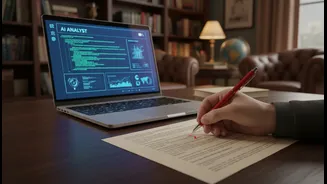
For decades, students have relied on basic spell checkers and grammar tools. But the new wave of Artificial Intelligence is in a different league. These are not just tools that spot typos; they are sophisticated assistants powered by natural language
processing (NLP) and machine learning. Think of them as a tireless proofreader available 24/7, designed to help you polish your work before that final submission. Instead of just flagging a misspelled word, these platforms can analyze sentence structure, suggest stylistic improvements, and ensure your tone is consistent, transforming the way students can refine their writing.
What Can AI Actually Catch?
Modern AI writing tools can identify a wide array of common research writing problems. They excel at catching complex grammatical mistakes like subject-verb agreement, incorrect punctuation, and awkward phrasing that older software would miss. They can also flag issues with clarity and readability, suggesting ways to break down long, convoluted sentences into more direct and understandable ones. Some tools are also adept at identifying repetitive phrasing and overused words, helping to make your prose more dynamic and engaging. This allows students to move beyond basic error-correction and focus on enhancing the overall quality and professionalism of their work.
Support for Structure and Citations
Beyond grammar, one of the biggest benefits is structural support. Advanced AI can analyze the flow and coherence of your arguments, checking if your claims are well-supported and if the logic is sound. This is a game-changer for students struggling to organize complex ideas. Furthermore, managing citations—a common source of stress and potential errors—is significantly streamlined. AI can help format references in styles like APA or MLA, check for consistency between in-text citations and the bibliography, and in some cases, even spot citations that appear to be fabricated or incorrect, a phenomenon known as AI 'hallucination'. This mechanical support frees up valuable time for students to concentrate on the research itself.
A Tool, Not a Replacement
While impressive, it is crucial to understand the limitations of AI. These systems do not understand the nuance of your argument or the originality of your ideas. They operate on patterns and can sometimes make suggestions that flatten your unique authorial voice, making it sound more generic or robotic. Over-reliance on AI can also prevent students from developing their own critical editing skills. Experts stress that AI should be used as an assistant, not as a replacement for human thought and judgment. The student is always the author and remains responsible for the final product, including any errors the AI might introduce or fail to catch.
Navigating Academic Integrity
The rise of AI has understandably raised questions about academic honesty. Using AI to check grammar, improve clarity, or format citations is widely considered an ethical use of a support tool. The line is crossed when a student uses AI to generate entire sections of text and presents it as their own work, which is a form of plagiarism. The key is transparency and intent. The goal is to use AI to enhance your own writing and learning, not to bypass the process altogether. Many universities are now developing clear policies on acceptable AI use, encouraging students to see it as a collaborative tool that, when used responsibly, supports learning.