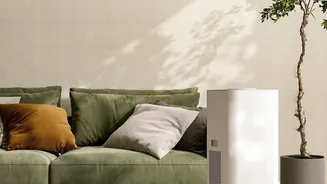





When the AQI is in the red, you trust your air purifier to create a safe haven at home. But what if it's not working? The most common reason is a mismatch between the purifier's capacity and your room's size. Here's how to get it right.
Why A Mismatch Is A Mistake
Choosing an air
purifier can feel overwhelming, but the single most important decision is getting the size right. It’s not just a recommendation on the box; it's physics. An undersized purifier simply cannot process the volume of air in your room fast enough to keep it clean. It will run constantly on its highest, noisiest setting, consuming more electricity while failing to remove pollutants effectively. This creates a false sense of security, where you believe you're breathing clean air when you're not. On the other hand, a unit that is excessively large for a small room can be an unnecessary expense and may even create uncomfortable drafts. The goal is to find the perfect balance for efficient, quiet, and effective air cleaning.
The Only Number That Really Matters: CADR
Forget the marketing jargon and focus on one key metric: CADR, or Clean Air Delivery Rate. This standard measurement, used globally and adopted by the Bureau of Indian Standards (BIS), tells you the volume of clean air a purifier produces per hour. It is typically measured in cubic metres per hour (m³/h) or cubic feet per minute (CFM). A higher CADR means the purifier can clean a larger space or clean the same space more quickly. Most purifiers will list three CADR numbers for smoke, dust, and pollen, which are common indoor pollutants. For general air quality concerns in urban Indian homes, the smoke CADR is often the most useful benchmark.
A Simple Rule for Sizing
The easiest way to get started is the 'two-thirds' rule. Your purifier's smoke CADR rating (in CFM) should be at least two-thirds of your room's area in square feet. For example, if your bedroom is 150 square feet, you will need a purifier with a CADR of at least 100 CFM (150 x 0.67 ≈ 100). To do this, first, measure your room. Multiply the length and width in feet to get the total square footage. A room that is 12 feet by 15 feet is 180 square feet. Applying the rule, you would need a purifier with a CADR of at least 120 CFM (180 x 0.67). This simple calculation ensures the machine has enough power for your space.
For Better Protection: Consider ACH
For a more precise approach, especially if you have allergies, asthma, or live in a high-pollution area, consider Air Changes per Hour (ACH). ACH tells you how many times the purifier can filter the entire volume of air in a room within one hour. An ACH of 5x means the air is cleaned every 12 minutes. Health experts recommend a minimum of 4–5 ACH for homes to effectively reduce airborne contaminants. To calculate the CADR needed for a specific ACH, you must also factor in your ceiling height. The formula is: CADR (in CFM) = (Room Volume in cubic feet × ACH) ÷ 60. For a 180 sq ft room with an 8–foot ceiling (1,440 cubic feet), aiming for 5 ACH would require a CADR of 120 CFM.
Beyond The Numbers: Other Factors
While CADR and ACH are critical for sizing, they aren't the only things to consider. Ensure the purifier has a true HEPA filter, which is designed to capture tiny, harmful particles. Also, check the noise levels (measured in decibels or dB), especially if the unit will be in a bedroom. A powerful purifier is useless if it's too loud to run while you sleep. Finally, consider the long term cost and availability of replacement filters. A purifier is only as good as its filter, and it must be replaced regularly to maintain performance.