



Meet the Planet of the Hour
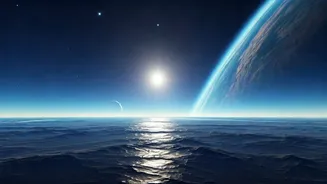
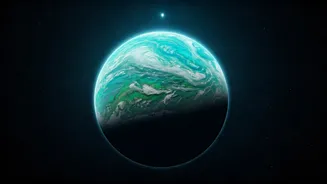
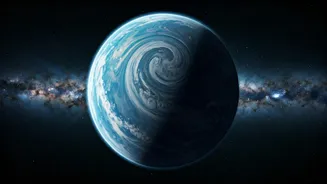
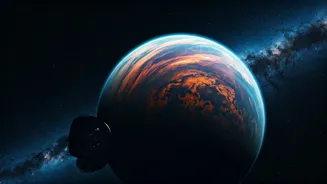
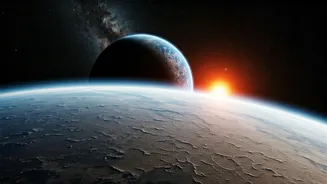
The focus of all this excitement is an exoplanet named K2-18 b, located about 124 light-years away. It’s not an Earth-twin; it's a 'super-Earth' or 'sub-Neptune,' clocking in at over eight times the mass of our own planet. What makes it special is its
position in its star's habitable zone—the orbital region where conditions might be just right for liquid water to exist on a planet's surface. For years, scientists have theorized about a new class of planets called 'Hycean' worlds, a portmanteau of 'hydrogen' and 'ocean'. These are hypothetical planets with vast, global oceans of liquid water underneath a thick, hydrogen-rich atmosphere. K2-18 b is shaping up to be the best candidate yet for this new planetary category.
The Chemical Fingerprints of a Water World
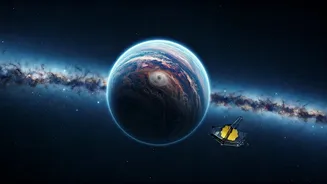
Using its powerful instruments, the James Webb Space Telescope (JWST) peered into the atmosphere of K2-18 b as the planet passed in front of its host star. The starlight filtering through the atmosphere revealed the clear presence of methane and carbon dioxide. Crucially, the telescope did not detect significant amounts of ammonia. This is a key piece of the puzzle. Scientists predict that ammonia should be present in a hydrogen-rich atmosphere, but it's also highly soluble in water. Its absence strongly suggests it might have been absorbed by a massive liquid ocean covering the planet's surface, bolstering the Hycean world theory. This atmospheric makeup is precisely what you would expect to see if there was a massive body of water interacting with the air above it.
A Possible Sign of Life?
Here's where the story goes from fascinating to truly groundbreaking. In addition to the other gases, the Cambridge University-led team reported a tentative detection of another molecule: dimethyl sulfide, or DMS. On Earth, DMS is almost exclusively produced by life, primarily by marine phytoplankton. Finding it on a potential ocean world is an electrifying prospect. The data isn't a slam dunk—it currently has a 'three-sigma' confidence level, meaning there's a 99.7% chance the signal is real, but scientists typically require a 'five-sigma' level for a confirmed discovery. Still, the possibility that JWST has sniffed out a potential biosignature—a chemical clue pointing to life—has sent ripples through the scientific community.
Let’s Not Get Ahead of Ourselves
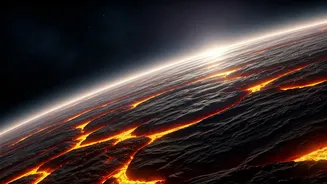
Before we welcome our new microbial overlords, it’s important to understand the scientific debate. The DMS detection is tentative, and some other research teams analyzing the same data have not been able to independently confirm the signal. Furthermore, there are alternative explanations for K2-18 b's nature. Some models suggest the planet might be too hot and its atmospheric pressure too high to support a liquid ocean. In this scenario, it wouldn't be a welcoming water world but a hellish mini-Neptune, with a steamy, dense atmosphere and perhaps even a surface of boiling magma. Even the status of DMS as a unique biosignature is being debated, with recent studies showing it can be produced by non-living processes. The scientific process is working as it should, with skepticism and rigorous verification at its core.
A Breakthrough, No Matter the Outcome
Regardless of whether K2-18 b is home to life, these observations represent a monumental leap in our search for it. For the first time, we have not only characterized the atmosphere of a potentially habitable exoplanet in detail but have also detected a gas that could, in theory, be a sign of biological activity. JWST has proven it has the power to do the job it was built for: to analyze the air of distant worlds and search for the chemical building blocks of life. Even if the DMS signal turns out to be a false alarm, this investigation on K2-18 b serves as a crucial dress rehearsal. It’s refining the techniques and sharpening the debates that will dominate astrobiology for the next decade.