





From Technopark to a Deep-Space Mission
When the UAE Space Agency needed a critical piece of technology for its ambitious Emirates Mission to the Asteroid Belt (EMA), it turned to HEX20, a space-tech company with its major engineering hub in Thiruvananthapuram's Technopark. In a historic collaboration,
HEX20 became the first Indian private company selected to contribute to a deep-space mission for the Gulf nation. Founded in 2020 by a group of Malayali entrepreneurs, HEX20 has quickly established itself as a key player in designing and manufacturing advanced satellite systems. The company, which also has operations in the UAE and Australia, was chosen by the Technology Innovation Institute (TII) and the UAE Space Agency to develop the probe's spacecraft bus, software, and robust onboard computer systems designed to survive the harsh environment of deep space. This selection is a powerful testament to the growing capabilities and global competitiveness of India's private space industry.
A Five-Billion-Kilometre Voyage
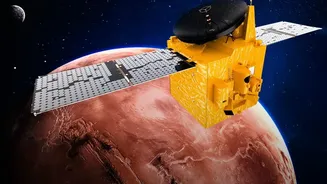
The mission itself is breathtaking in its ambition. Scheduled for launch in March 2028, the main spacecraft, named the MBR Explorer, will embark on an epic journey that spans roughly five billion kilometres. Using gravity-assist manoeuvres from Venus, Earth, and Mars, the explorer will navigate its way to the main asteroid belt located between Mars and Jupiter. Along its path, it will fly by and observe six different asteroids. However, its primary target is a unique and scientifically intriguing asteroid named 269 Justitia. The MBR Explorer is expected to reach the vicinity of Justitia in 2034, setting the stage for the mission's most critical phase. The long duration and complex trajectory of the mission highlight the extreme reliability required of every component, including those developed by HEX20.
The Deployable Probe's Crucial Role
This is where HEX20's technology takes centre stage. The 'deployable probe' is an autonomous lander developed by the company. Once the MBR Explorer is in orbit around asteroid 269 Justitia, it will deploy this lander. The probe will then separate from the mothership and begin an autonomous descent to the asteroid's surface, a process expected to occur around 2036. Its job is to survive the landing and transmit invaluable data and images back to Earth. Scientists are particularly interested in Justitia because of its unusual reddish surface, which suggests it could hold clues about the presence of organic materials and water during the formation of our solar system. HEX20's work involved not just building the physical spacecraft bus but also the highly specialised software required for this complex autonomous landing and data-gathering operation.
A Watershed Moment for Indian Space-Tech
The success of India's private space sector has been rapidly accelerating, with companies like Skyroot and Agnikul making headlines for their launch vehicles. HEX20's achievement represents another, equally important, leap forward. It proves that Indian firms can not only build hardware for local needs but can also be trusted partners in sophisticated, high-stakes international deep-space missions. This project moves beyond Low Earth Orbit (LEO) and demonstrates capability in interplanetary exploration, a far more demanding field. The involvement in the EMA mission showcases an ability to deliver complex systems that meet stringent international quality and technical standards, paving the way for more global collaborations. It's a clear signal that India's goal of capturing a larger share of the global space economy, estimated to be worth hundreds of billions of dollars, is well within reach.