



Day 1: Arrival in the Temple City
Your journey begins in Bhubaneswar, Odisha’s capital, often called the 'Temple City of India'. After settling in, immerse yourself in the architectural splendour of the Kalinga period. Start with the 11th-century Lingaraj Temple, a magnificent structure
dedicated to Lord Shiva that dominates the city's skyline. Nearby, the Mukteshwar Temple, a 10th-century gem, is celebrated for its intricate stone carvings and a beautiful arched gateway, or 'torana'. These temples aren't just historical monuments; they are living places of worship. Notice the carved motifs of dancers, deities, and floral patterns—designs that you will soon see mirrored in the textiles woven in villages not far from here. The art and faith carved in stone provide the first layer of context for the craft you are about to discover.
Day 2: The Weavers of Nuapatna
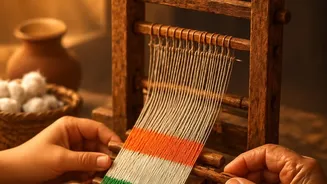
A road trip takes you towards the handloom heartlands. Today’s destination is Nuapatna, a weaving village in the Cuttack district. This area is famous for Khandua silk, a fabric historically woven for Lord Jagannath in Puri. Here, you'll witness the 'Bandha' or Ikat process for the first time. This resist-dyeing technique involves meticulously tying sections of yarn to prevent them from absorbing colour during dyeing. The weavers, many of whom have inherited this skill over generations, create mesmerising patterns. Verses from the poet Jayadeva’s 'Gita Govinda' have historically been woven into these silks, a testament to the deep connection between faith and fabric. Visiting the weavers' homes, where looms often occupy the main room, offers an intimate look at this painstaking art form.
Day 3: The Sambalpuri Legacy in Bargarh
Today you travel west to the epicentre of the craft: the districts of Bargarh and Sambalpur. This region is the home of the world-renowned Sambalpuri Ikat. Unlike the weft-ikat prominent in Nuapatna, this area is known for both single and double Ikat, a far more complex technique where both warp and weft threads are tie-dyed before weaving. Visit weaving clusters like Barpali or Sonepur, where the rhythmic clatter of pit looms fills the air. The weavers, primarily from the Bhulia community, work with incredible precision, lining up the pre-dyed threads to form intricate designs. The patterns emerge not from printing or embroidery, but from the very structure of the cloth, making the design appear identically on both sides. This is the hallmark of genuine Sambalpuri Bandha.
Day 4: Reading the Motifs
Having seen the process, today is about understanding the language of the loom. Sambalpuri textiles are rich with symbolism. You’ll learn to identify key motifs: the 'shankha' (conch shell), 'chakra' (wheel), and 'phula' (flower) are pillars of the design vocabulary, often linked to the iconography of Lord Jagannath. Animal and bird motifs like fish, elephants, and peacocks speak of the region's biodiversity, while the 'pasapali' or chessboard pattern is another classic design. Many of these symbols echo the carvings you saw on the temples in Bhubaneswar, creating a beautiful synergy between Odisha’s architectural and textile traditions. Buying a saree or fabric directly from a weaver or a local cooperative society ensures you are supporting the artisans who keep this tradition alive.
Day 5: The Sun Temple and Departure
Before concluding your tour, a visit to the Konark Sun Temple, a UNESCO World Heritage site, is essential. Shaped like a colossal chariot for the Sun God, its massive, intricately carved stone wheels are iconic. This 13th-century marvel represents the pinnacle of Kalinga architecture and serves as a final, powerful reminder of the artistic genius that flows through Odisha. The temple's grandeur provides a profound final context for the handwoven masterpieces you've encountered. From Konark, it’s a scenic drive back to Bhubaneswar for your departure, carrying with you not just a beautiful textile, but the story of the hands that made it and the culture that shaped it.