



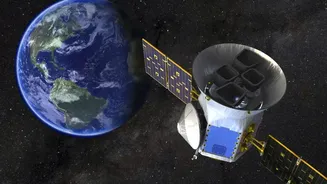
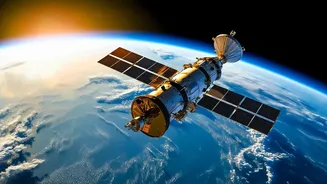

The digital cloud is about to get a lot closer to actual clouds. A new wave of companies is looking to move power-hungry data centres from Earth into orbit, but the concept is creating an unexpected conflict with the view of our night sky.
Why Put a Data Centre in Orbit?
The massive
server farms that power our digital world consume astonishing amounts of energy and water. On Earth, this creates a major logistical and environmental challenge. But in space, some of the biggest problems disappear. In a sun-synchronous low-Earth orbit, satellites can receive nearly continuous sunlight, providing a constant source of power that terrestrial solar farms can only dream of. Cooling, another huge expense for ground-based centres, is also simplified; in the vacuum of space, excess heat can be radiated away passively. This has led companies like Starcloud, Google, and Blue Origin to develop plans for orbital data centres, aiming to serve the explosive growth in artificial intelligence and cloud computing. The vision is to create a new layer of infrastructure that is secure, scalable, and less dependent on Earth's strained resources.
An Unexpected and Glaring Problem
The very design that makes these satellites efficient also makes them a menace to the night sky. To generate gigawatts of power and radiate away immense heat, these orbital data centres would require massive solar arrays and radiator panels, potentially stretching kilometres across. Recent studies project that a single large orbital computing facility could have a solar array up to 140,000 times larger than a current Starlink satellite. This immense, reflective surface area would turn the satellites into some of the brightest objects in the sky. One analysis suggests a large data centre in orbit could be 100 times brighter than Venus, one of the brightest objects in the night sky. Rather than appearing as faint, moving stars, they would look like a chain of brilliant industrial objects marching across the sky for hours after sunset and before sunrise.
A 'Catastrophic' Threat to Astronomy
For astronomers, this is a nightmare scenario. The reflected sunlight from these mega-satellites would create bright streaks across telescope images, effectively blinding them. These streaks can ruin long-exposure observations aimed at detecting faint and distant objects like far-off galaxies or potentially hazardous asteroids. The International Astronomical Union (IAU), the global body representing professional astronomers, has raised serious concerns. The problem goes beyond just streaks; the collective glow from thousands of these satellites would increase the overall brightness of the night sky, creating a form of light pollution that is impossible to escape, even in the most remote observatories. This threatens to undo decades of investment in ground-based astronomy and could fundamentally compromise our ability to study the universe from Earth.
The Push for Brightness Limits
In response, the astronomy community is urgently calling for regulations. The IAU has recommended a brightness limit for satellites, suggesting they should not be visible to the naked eye, which corresponds to an apparent magnitude of 7.0 or fainter. However, many existing communications satellites from mega constellations already exceed this limit, and the proposed data centres would be dramatically brighter still. Currently, there are no formal international or national regulations that specifically govern satellite brightness or optical interference. While radio astronomers have legal protections against interference, optical astronomers do not. This regulatory vacuum means that companies are largely operating on voluntary measures, which have proven inconsistent.
A Crowded and Contested Future
The debate over space-'based data centres is part of a larger conversation about the commercialisation of low-'Earth orbit. As launch costs fall, the number of satellites is projected to explode, with companies filing applications for tens,' or even hundreds,' of thousands of new spacecraft. This creates a complex challenge that balances technological innovation and commercial opportunity against the preservation of the night sky as a shared global commons for science and culture. Without proactive international agreements and binding regulations, the conflict between a brighter,' more industrialised orbit and a dark,' observable sky is set to intensify. The search is on for solutions,' from developing less-'reflective satellite coatings to new software for observatories,' but the scale of the challenge is unprecedented.