





What Exactly Is a Temporary Moon?
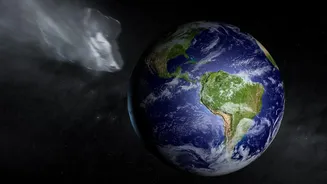
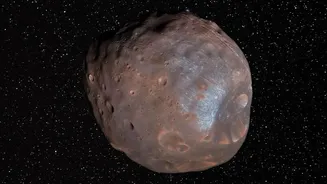
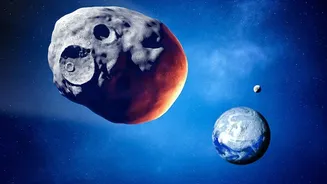
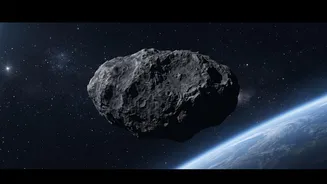
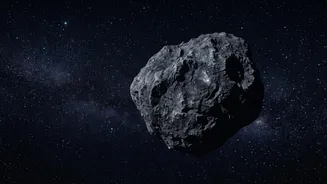
A temporary moon, or 'minimoon', is an asteroid or other small celestial body that gets captured by a planet's gravity for a short period. Unlike our permanent Moon, which has been in a stable orbit for billions of years, these visitors are just passing
through. They fall into an unstable orbit for a few months or years before the gravitational pull of the Sun and other planets eventually flings them back out into space to continue their journey around the Sun. The process requires a perfect cosmic coincidence: the object must approach Earth at just the right speed and angle to be caught, rather than flying past or crashing into our atmosphere.
Meet 2026 QQ8: Our Newest Companion
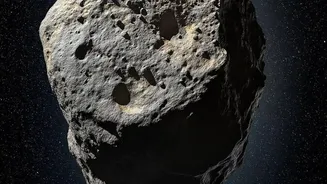
The newest addition to our celestial family, 2026 QQ8, is a tiny asteroid measuring about two meters (around 6 feet) in diameter. It was first spotted by Hungarian astronomer Krisztián Sárneczky in August 2026. Initially, astronomers were unsure if it was a natural object or a piece of human-made space debris. However, after several weeks of observation, the International Astronomical Union's Minor Planet Center confirmed it was a natural asteroid and gave it its official designation in late October 2026. Orbital calculations show that it was captured by Earth's gravity in April 2026 and is expected to leave its temporary orbit in early December 2026.
The Delicate Dance of Asteroid Capture
Capturing a minimoon is a rare and delicate event. Most asteroids that approach Earth are moving too fast to be caught by our planet's gravity; they simply get a gravitational slingshot and continue on their way. For an object to be captured, it needs to enter what is known as Earth's 'Hill sphere' — the region of space where our planet's gravity is the dominant force. It must do so with a low relative velocity, allowing Earth to pull it into a temporary, often chaotic and looping orbit. Simulations suggest that at any given time, Earth is likely hosting at least one minimoon of about a meter in size, but their small size and speed make them incredibly difficult to detect with current surveys.
Why Are These Mini-Moons So Important?
Temporary moons like 2026 QQ8 are a huge opportunity for scientists. They provide a chance to study an asteroid up close without the immense cost and time required for a deep-space mission. By observing them, astronomers can learn more about the composition of asteroids, which are pristine remnants from the formation of our solar system. Studying their material can offer clues about how planets formed and how water and organic molecules may have been delivered to a young Earth. Furthermore, these minimoons serve as valuable testbeds for developing technologies for planetary defense and future asteroid mining operations, allowing scientists to practice tracking and navigating around near-Earth objects.
A Fleeting and Harmless Visitor
You won't be able to see 2026 QQ8 with the naked eye; it is far too small and dim. Even at its closest approach, it remains hundreds of thousands of kilometers away, farther than our main Moon. There is no risk of it colliding with our planet. Even if its trajectory were to lead it toward us, an object this small would safely burn up and disintegrate in Earth's atmosphere, at most creating a bright fireball or meteor. The discovery of 2026 QQ8 follows other notable temporary moons like 2006 RH120 and 2020 CD3, which also orbited Earth for about a year and three years, respectively. Each discovery helps refine our understanding of these transient celestial events.