



Our Cosmic Neighbourhood
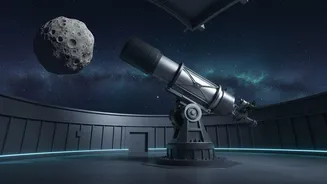
The solar system isn't empty. It's filled with ancient debris left over from its formation, much of it in the form of asteroids and comets. Objects whose orbits bring them within 45 million kilometres of Earth's path are called Near-Earth Objects, or NEOs.
While most are harmless, some are classified as Potentially Hazardous Objects (PHOs) if they are large enough—typically over 140 metres in diameter—and their orbits intersect with Earth's. An impact from an object this size could devastate a city or region. We don't have to look to the dinosaurs for a reminder of the threat; in 2013, an undetected 20-metre asteroid exploded over Chelyabinsk, Russia, with the force of an atomic bomb, injuring about 1,500 people. This event was a wake-up call, highlighting that even relatively small objects pose a significant danger.
The Global Watchtowers
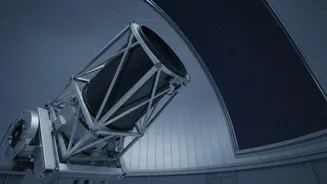
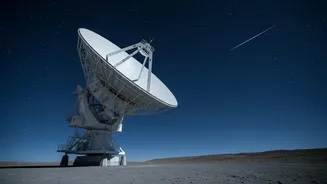
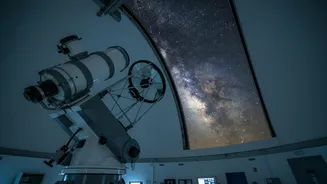
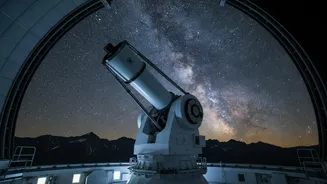
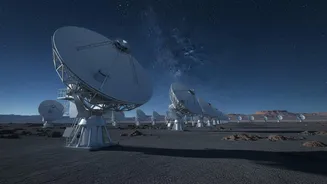
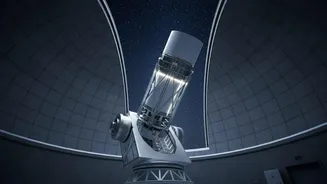
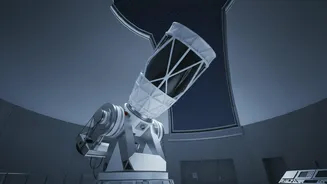
Finding these threats before they find us is the mission of planetary defense. This isn't the work of one country but a coordinated international effort. NASA's Planetary Defense Coordination Office (PDCO), established in 2016, plays a leading role, working with partners like the European Space Agency (ESA) and the International Asteroid Warning Network (IAWN). The backbone of this effort is a network of survey telescopes. Operations like the Catalina Sky Survey in Arizona and the Pan-STARRS telescope in Hawaii are responsible for the vast majority of all NEO discoveries. These telescopes repeatedly image large patches of the night sky. By comparing these images, automated software can spot the faint points of light that move against the static background of stars, flagging them as potential NEOs. This data is then shared globally via the Minor Planet Center, a clearinghouse for all asteroid and comet observations.
From Detection to Deflection
Spotting an object is just the first step. Once a potential NEO is identified, other telescopes around the world conduct follow-up observations to precisely calculate its size, shape, and, most importantly, its orbit. This allows scientists to predict its future path and determine if it poses any risk of impacting Earth in the coming decades. If a credible threat is found, the goal is to provide a warning not of days or weeks, but of years or decades. This long lead time is crucial for mounting a response. For years, the primary response strategy was theoretical: using a 'kinetic impactor' to ram a spacecraft into an asteroid to nudge it off course. This theory was put to a spectacular and successful test in 2022.
A Practice Run for Planetary Safety
NASA's Double Asteroid Redirection Test (DART) mission was humanity's first real-world planetary defense test. The DART spacecraft traveled to the asteroid Dimorphos and, in a landmark moment, intentionally slammed into it. The collision was a resounding success. It altered Dimorphos's orbit around its parent asteroid by 32 minutes, far exceeding the mission's minimum goal. The impact created a massive plume of debris, and the recoil from this ejecta gave the asteroid an even greater push than the spacecraft itself. The DART mission proved that deflecting a hazardous asteroid is technologically possible. The European Space Agency's upcoming Hera mission will visit Dimorphos to study the aftermath of the impact, providing more crucial data for future defense efforts.
Why the Watch Must Be Constant
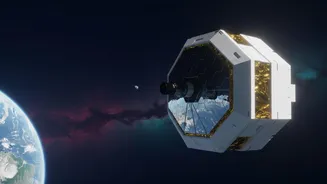
Even with the success of DART, the search is the most critical component. We can't deflect an asteroid we haven't found. The watch must be constant because asteroids are often dark, small, and can approach from directions that are difficult to observe from the ground, such as from the direction of the sun. To find these hidden threats, new tools are being developed. NASA's upcoming NEO Surveyor is a space-based infrared telescope designed to find asteroids by their heat signatures. From its vantage point in space, unhindered by weather or daylight, it will dramatically accelerate the discovery of the remaining undiscovered NEO population. The constant, vigilant watch by this global network of telescopes is our best and only defense against a predictable, and preventable, natural disaster.