



Listening to Spacetime Ripples
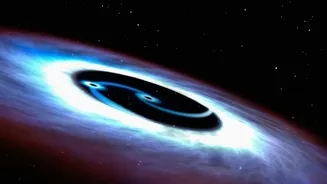
Imagine dropping two massive bowling balls onto a trampoline. As they spiral towards each other, they would create waves in the fabric. Now, scale that up to the cosmic level. When colossal objects like black holes or neutron stars accelerate and collide,
they create ripples in the very fabric of spacetime itself. First predicted by Albert Einstein in 1916, these gravitational waves travel outwards from their source at the speed of light. For a century, they were purely theoretical. That changed in 2015 when the Laser Interferometer Gravitational-Wave Observatory (LIGO) made the first direct detection, opening a new way of observing the cosmos. Instruments like LIGO, Virgo in Italy, and KAGRA in Japan act as celestial ears, detecting the minuscule stretching and squeezing of spacetime as a wave passes by.
The Black Hole Family Portrait
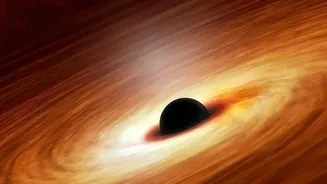
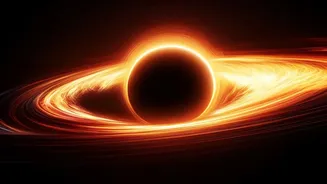
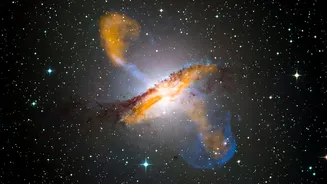
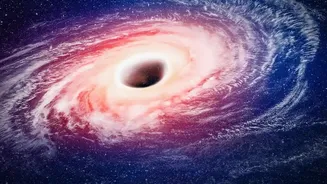
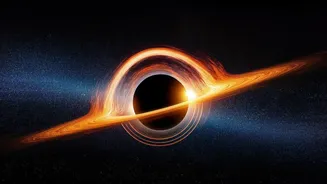
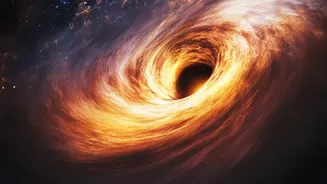
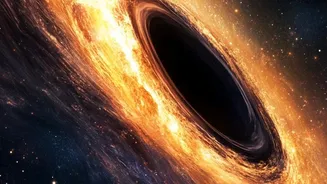
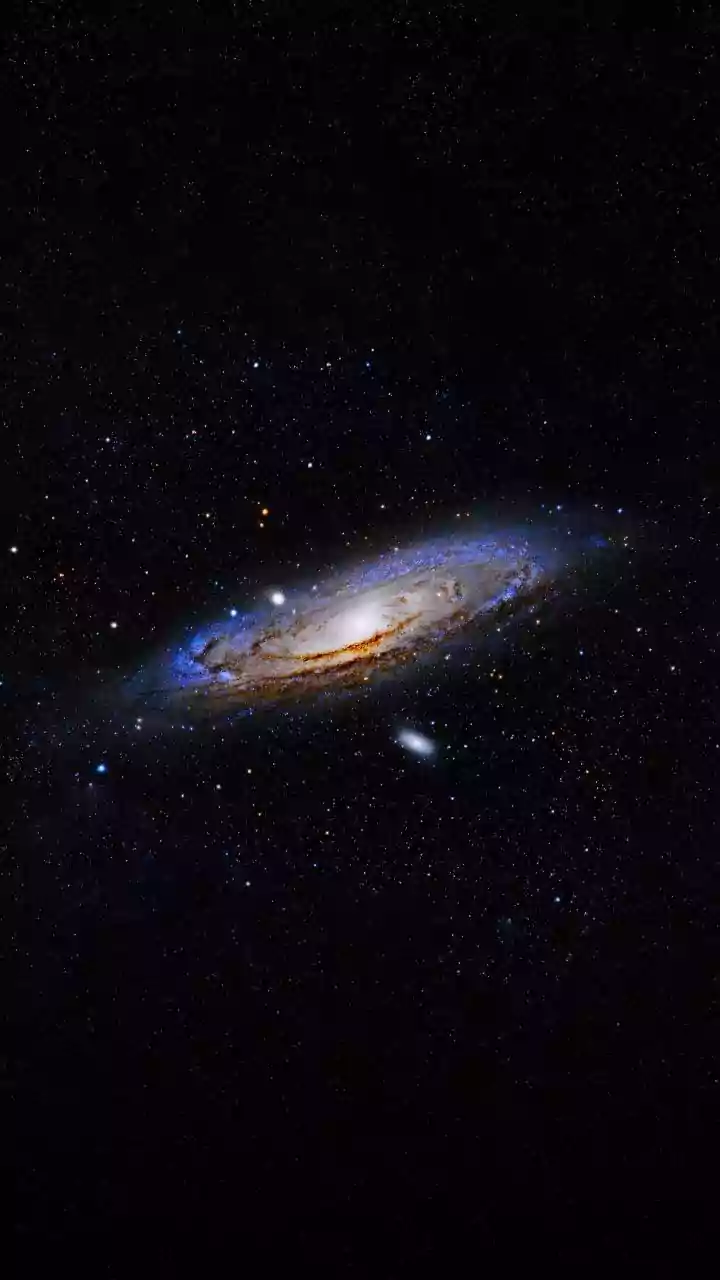
Until recently, astronomers knew of two main classes of black holes. The first are stellar-mass black holes, typically five to a hundred times the mass of our sun, which form when a single massive star collapses at the end of its life. At the other extreme are the supermassive black holes, behemoths weighing millions or even billions of solar masses, which anchor the centers of most large galaxies, including our own Milky Way. This left a massive gap in the family album. Scientists theorized there must be a middle category, called intermediate-mass black holes (IMBHs), with masses ranging from 100 to 100,000 times that of the sun. For decades, however, finding definitive proof of their existence was incredibly challenging, earning them the nickname of the 'missing link' in black hole evolution.
The Hunt for the Cosmic Middle Child
Finding these IMBHs is crucial because they could solve a major cosmic puzzle: how do supermassive black holes get so big? One leading theory is that they grow through a series of mergers, starting with smaller black holes that combine over billions of years. IMBHs would be the perfect stepping stone in this process of hierarchical growth. However, they are fiendishly difficult to spot. They are not as active as the supermassive giants at galactic centers, and they are too large to be formed from a single star's collapse. Recent analyses of data from the LIGO-Virgo-KAGRA (LVK) collaboration have been specifically designed to search for the unique gravitational wave signatures produced when these mid-sized objects collide.
What the New Ripples Reveal
The latest analysis of gravitational wave events has provided some of the strongest evidence yet for IMBHs. By meticulously decoding the frequency and amplitude of the spacetime ripples, scientists can infer the masses of the colliding objects. Events like GW190521, for example, involved the merger of two black holes weighing around 85 and 66 solar masses, resulting in the formation of a new, 142-solar-mass black hole—the first one ever definitively detected in the intermediate range. Another powerful merger, GW231123, created a final black hole of approximately 225 solar masses. These signals confirm that such mergers are happening and provide a direct look at the 'lite' IMBH population. The analysis of these waves, which can last for just a fraction of a second, allows researchers to test the limits of Einstein's theory of general relativity and refine models of how these extreme objects behave.