



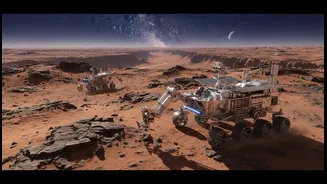



Lesson 1: Pack a 'Forever' Battery
Unlike solar-powered rovers that can be crippled by dust storms or Martian winter, Perseverance runs on a nuclear battery. It’s called a Multi-Mission Radioisotope Thermoelectric Generator (MMRTG), and it provides a steady, reliable flow of electricity
by converting heat from the natural decay of plutonium-238. This power source gives it about 110 watts of power, day and night, for a designed life of at least 14 years. This consistent energy allows engineers to operate its instruments and heaters regardless of the weather, a crucial factor in its longevity and a powerful lesson in designing for the worst-case scenario, not just the best.
Lesson 2: Teach Your Robot to Drive Itself
With a signal delay of up to 44 minutes for a round trip, driving a rover from Earth is impossibly slow. Perseverance's marathon pace is possible because it can think for itself. Its advanced autonomous navigation system, an upgraded version of AutoNav, lets the rover build 3D maps of its surroundings, identify hazards like sharp rocks or sand traps, and plot its own safe path forward. Recently, it gained an even more powerful ability called Mars Global Localization. This new system acts like a planetary GPS, allowing the rover to pinpoint its location with incredible accuracy by matching images it takes with orbital maps, all without human help. This reduces its reliance on mission control and allows it to cover far more ground than any previous rover.
Lesson 3: Evolve from Your Predecessors
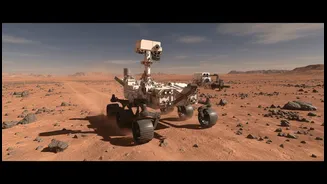
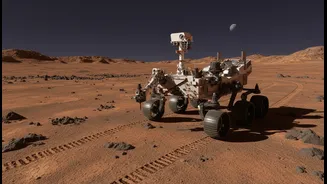
Perseverance wasn't designed in a vacuum. It stands on the shoulders—or wheels—of its predecessor, Curiosity. Engineers at NASA's Jet Propulsion Laboratory took years of data from Curiosity's mission and made critical improvements. One of the most important was redesigning the wheels. While Curiosity’s wheels suffered significant damage from sharp Martian rocks, Perseverance was equipped with wheels that are narrower but have a larger diameter and are made of thicker, more robust aluminum. This seemingly small change has kept its wheels in fantastic shape, enabling it to confidently traverse the rugged terrain of Jezero Crater and climb over 1,300 feet up its rim.
Lesson 4: Always Have a Plan B (and a Twin)
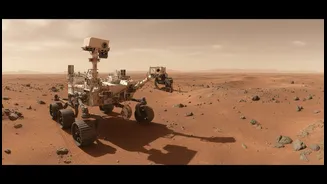
What happens when a problem occurs 130 million miles away? You solve it on Earth first. NASA operates a full-scale, functioning twin of Perseverance called OPTIMISM (Operational Perseverance Twin for Integration of Mechanisms and Instruments Sent to Mars). This Earth-bound rover lives in a simulated Martian landscape called the Mars Yard. Before sending risky commands to Mars—like drilling on a steep slope—engineers run the procedure on OPTIMISM first. This practice of rigorous testing and having a physical duplicate to troubleshoot with is a masterclass in risk mitigation for any complex engineering project.
Lesson 5: The Marathon is for a Purpose
The rover recently surpassed the marathon distance of 42.195 kilometers. But the distance itself isn't the ultimate goal. The marathon is the journey, not the destination. Every meter driven is in service of its primary mission: astrobiology. Perseverance is the first rover sent specifically to search for signs of ancient microbial life. Its journey has been carefully planned to explore the ancient river delta of Jezero Crater, a place scientists believe could have harbored life billions of years ago. The rover is collecting and caching dozens of rock core samples in pristine tubes, creating a scientific treasure chest for a future mission to collect and return to Earth for analysis.