




Our Star's Violent Temper
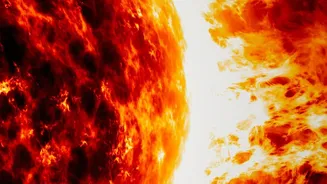
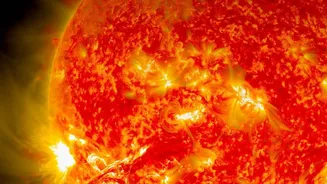
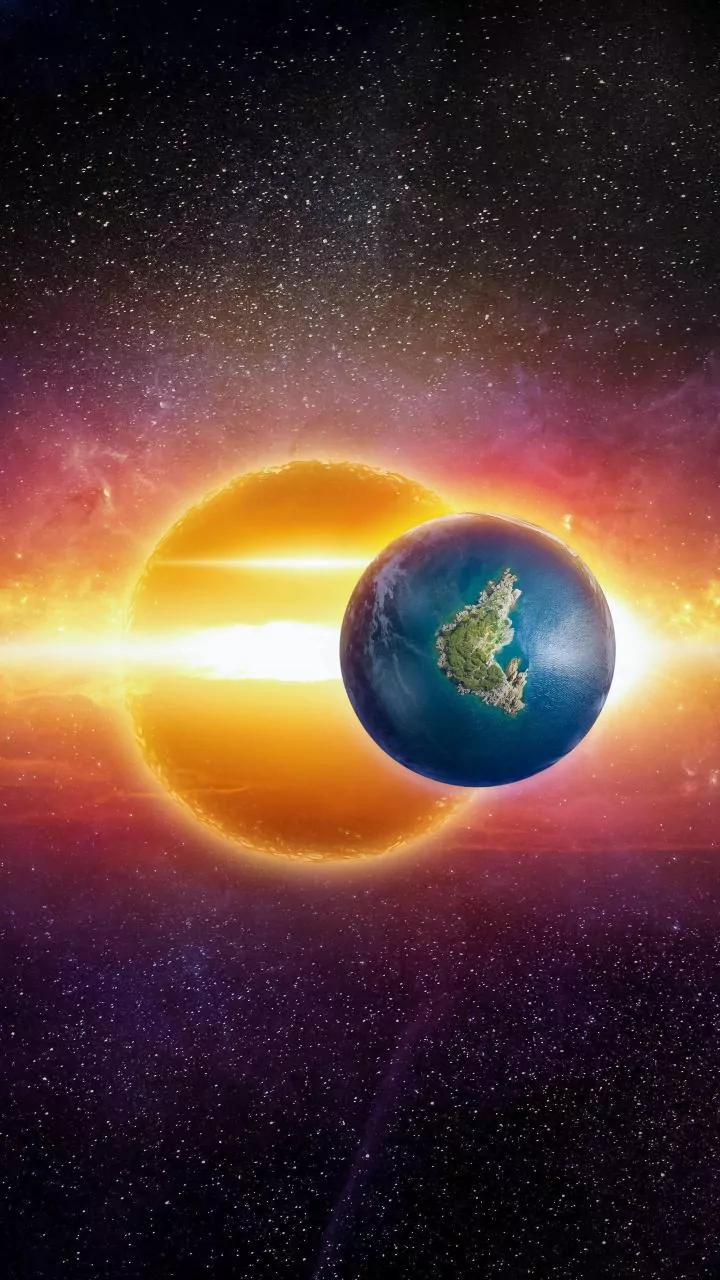
The sun, our life-giving star, has a volatile side. It periodically releases massive bursts of energy and matter in events known as solar flares and Coronal Mass Ejections (CMEs). A solar flare is an intense burst of radiation, while a CME is a colossal
bubble of plasma and magnetic field that erupts from the sun's corona. While the sun produces about three CMEs every day during its active periods, only a small fraction are aimed at Earth. However, when a powerful, Earth-directed CME occurs, these billions of tonnes of solar particles can travel at immense speeds, interacting with our planet's magnetic shield.
The Risk to a Connected World
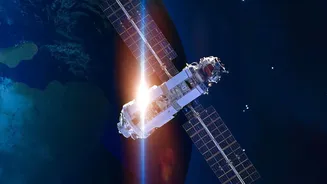
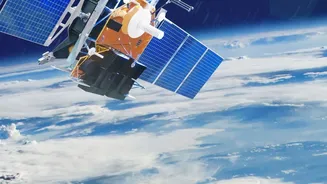
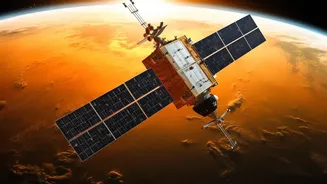
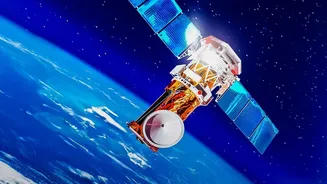
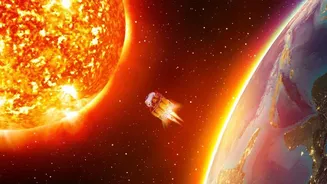
Our increasing reliance on technology makes us vulnerable to these cosmic events. For satellites orbiting outside Earth's protective atmosphere, solar storms pose a dual threat. Energetic particles can damage sensitive electronics and degrade solar panels, shortening a satellite's lifespan. Furthermore, a storm can heat and expand Earth's upper atmosphere, increasing atmospheric drag on spacecraft in low-Earth orbit. This can cause satellites to lose altitude, requiring course corrections or even leading to them burning up. Down on the ground, the danger is just as real. A severe geomagnetic storm can induce powerful currents in long conductors like power lines. These currents can overload transformers, leading to damage and potentially widespread, long-lasting blackouts, as witnessed in Quebec in 1989. Our communications, GPS navigation, and financial systems all depend on infrastructure vulnerable to solar activity.
Our Eyes on the Sun
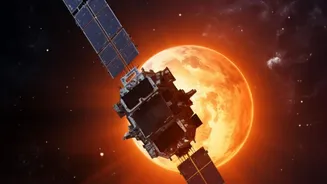
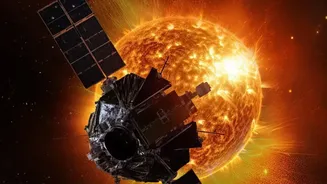
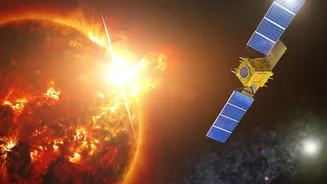
To counter this threat, a global network of observatories keeps a constant watch on the sun. This is the frontline of space weather forecasting. Agencies like the USA's Space Weather Prediction Center (SWPC) use data from a fleet of satellites to monitor solar activity. A key vantage point is Lagrange Point 1 (L1), a gravitationally stable spot 1.5 million kilometres from Earth, which offers an uninterrupted view of the sun. This is home to spacecraft like the Deep Space Climate Observatory (DSCOVR) and India's own pioneering solar observatory, Aditya-L1. Launched by ISRO, Aditya-L1 is equipped with seven payloads to study the sun's atmosphere and the solar wind, providing crucial data for understanding and forecasting these events.
From Early Warning to Action
When a potentially hazardous CME is detected, the race against time begins. Because light travels faster than the ejected solar plasma, we can see a flare as it happens, but the associated particles may take several hours to days to reach Earth. This provides a critical warning window. Forecasters use models like WSA-Enlil to predict if, when, and how strongly a CME will impact Earth. Upon receiving an alert, satellite operators can take protective measures, such as placing spacecraft into a safe mode or reorienting them to protect sensitive components. Power grid managers can prepare by reducing load on the system, discontinuing maintenance, and readying standby generators to help mitigate the impact of geomagnetically induced currents. Recent findings from India's Aditya-L1 mission have even identified small brightening events that occur hours before a major flare, offering the potential for even earlier warnings in the future.
A Continuous Vigil for a Safer Future
While monitoring cannot stop a solar storm, it is our most vital tool in ensuring the safety and resilience of our critical infrastructure. The goal is to move from reacting to space weather to proactively forecasting it with greater accuracy. This requires continuous observation, improved modelling, and international collaboration. Missions like Aditya-L1 are not just about pure science; they are a fundamental part of a global defence system. As we become ever more dependent on space-based technology and interconnected power systems, the silent, tireless work of solar storm monitors becomes increasingly important, safeguarding the very foundations of our digital society from the raw power of our own star.