





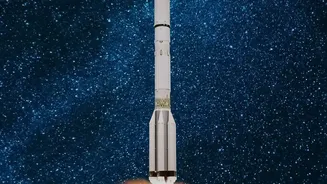

A New Space Race, Within India
For decades, the Indian space story was written almost exclusively by the Indian Space Research Organisation (ISRO). But the launch of the Indian Space Policy in 2023 fundamentally altered the sector's trajectory. By opening the doors to private companies
for end-to-end space activities, the government didn't just invite participation; it ignited a boom. Today, over 400 space-tech startups are operational in India, transforming the country into a global hub for space innovation. This new ecosystem, featuring government enablers like IN-SPACe, is not just supplementing ISRO's efforts but creating an entirely new economic engine, projected to be worth nearly $44 billion by 2033. For job seekers, this means the Indian space dream is no longer a single destination but a constellation of exciting opportunities.
The Rocket Builders: Core Engineering Roles
The most visible part of the new space boom is the hardware. Companies like Hyderabad's Skyroot Aerospace, which launched India's first private rocket, and Chennai's Agnikul Cosmos, with its 3D-printed engines, are at the forefront of building the vehicles that will carry satellites to orbit. This has created immense demand for core engineering talent. These companies are actively hiring Aerospace Engineers to design vehicle structures, Propulsion Engineers to develop powerful engines, and Avionics Engineers to build the electronic brains of the rocket. Roles in thermal engineering, structural analysis, and mechanical design are also critical, as startups race to build reliable and cost-effective launch solutions. A career here means working in a fast-paced environment where your contributions can go from a design file to the launchpad in record time.
The Data Miners: Software and Analytics Careers
Launching hardware is only half the story. The real value for many new space companies lies in the data gathered from orbit. Bengaluru-based Pixxel, for example, is building a constellation of the world's highest-resolution hyperspectral satellites, designed to monitor the planet's health. This has opened up a massive field for software and data professionals. Satellite Data Analysts with skills in remote sensing and GIS are needed to interpret terabytes of imagery for clients in agriculture, mining, and environmental monitoring. AI and Machine Learning specialists are in high demand to automate this analysis and find patterns that the human eye might miss. Furthermore, every spacecraft requires complex embedded software for flight control and mission operations, creating jobs for coders proficient in C++ and Python. As the number of satellites grows, so does the need for cybersecurity experts to protect these valuable assets.
The Mission Support: Business and Operations Roles
A space company is still a company. It needs more than just engineers to function and grow. As startups mature, they are building out robust business and support teams. This means there are now pathways into the space sector for professionals from diverse backgrounds. Program Managers are needed to keep complex, multi-year projects on schedule and within budget. Finance professionals manage multi-million-dollar funding rounds and create sustainable business models. With a complex web of national and international regulations, Space Lawyers are becoming increasingly vital. As companies like Dhruva Space note, they are looking for not just engineers but also communicators and those passionate about the 'Business of Space'. Roles in supply chain management, human resources, and marketing are also expanding, proving that you don't need an aerospace degree to be part of India's space journey.
How to Plot Your Trajectory
Entering this dynamic field requires a combination of foundational knowledge and practical skills. While a degree in engineering, physics, or computer science is a common starting point, companies are increasingly looking for demonstrated, hands-on experience. Building a portfolio through university projects, such as building a CubeSat or participating in robotics competitions, can make an application stand out. Proficiency in specific software and programming languages is key: CAD tools and finite element analysis (FEA) software for mechanical roles, and Python or C++ for software and data positions. Aspiring candidates should actively follow the careers pages of leading startups like Skyroot, Agnikul, and Pixxel and connect with the growing space community online and at industry events. With talent being drawn from ISRO and a competitive global market, upskilling and continuous learning are essential to launching a successful career in this sector.