




What Am I Looking For?
Forget what you know about planes. The International Space Station (ISS) appears as a very bright, steady white light moving silently and purposefully across the night sky. It doesn't have the blinking red and green lights of an aircraft. To the naked
eye, it looks like a brilliant, fast-moving star and is often the brightest object in the sky after the Moon. It travels at an astonishing 28,000 kilometres per hour, completing an orbit of our planet every 90 minutes. This incredible speed means it will cross your entire field of view in just a few minutes, so you need to be ready.
The Science of the Sighting
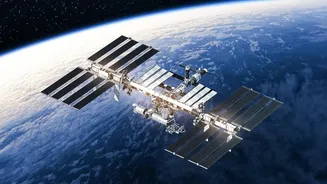
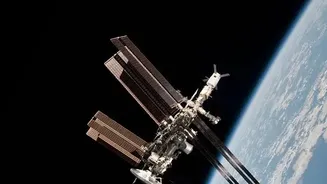
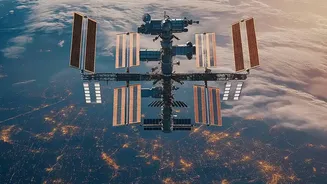
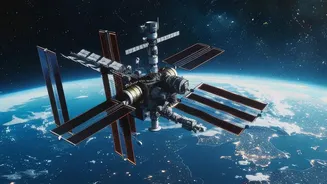
The ISS isn't visible because of its own lights, but because its massive solar arrays and modules reflect sunlight back down to Earth. This is the same reason we can see the Moon. Because it relies on reflected sunlight, sightings are only possible during a specific window: the hours just after sunset or just before sunrise. During this twilight period, the sky on the ground is dark, but the ISS, at its high altitude, is still bathed in sunlight. This creates the perfect contrast for viewing. Its orbit has an inclination of 51.6 degrees, meaning it passes over 90% of the world's population, including all of India, making sightings a regular occurrence.
Upcoming Sighting Times for Major Cities
Sighting opportunities are specific to your location and change frequently. The times below are for the week of August 17, 2026, and show when the ISS will be visible. 'Max Height' tells you how high it will be from the horizon (90 degrees is directly overhead). New Delhi: - Tue, Aug 18, 5:21 AM; Visible: 6 min; Max Height: 75°; Appears: WSW, Disappears: NE. - Wed, Aug 19, 4:33 AM; Visible: 5 min; Max Height: 45°; Appears: SW, Disappears: ENE. Mumbai: - Wed, Aug 19, 5:48 AM; Visible: 6 min; Max Height: 85°; Appears: NW, Disappears: SE. - Thu, Aug 20, 5:01 AM; Visible: 4 min; Max Height: 30°; Appears: W, Disappears: NNE. Bengaluru: - Tue, Aug 18, 5:10 AM; Visible: 5 min; Max Height: 28°; Appears: NNW, Disappears: E. - Wed, Aug 19, 5:53 AM; Visible: 6 min; Max Height: 42°; Appears: NW, Disappears: SSE. Kolkata: - Mon, Aug 17, 4:55 AM; Visible: 6 min; Max Height: 68°; Appears: W, Disappears: SE. - Tue, Aug 18, 5:39 AM; Visible: 5 min; Max Height: 35°; Appears: WNW, Disappears: S.
How to Prepare for the Perfect View
You don't need a telescope or binoculars; the ISS is bright enough to be seen with the naked eye. For the best experience, find a viewing spot away from tall buildings and bright city lights about 15 minutes before the pass is scheduled to begin. This allows your eyes to adjust to the darkness. Knowing the direction it will appear from (e.g., 'WSW' for west-southwest) is crucial. Face that direction and scan the sky. To get the most accurate, up-to-the-minute schedules for your specific neighbourhood, use a dedicated app. NASA's official Spot The Station app, ISS Detector, and websites like Heavens-Above are excellent resources that can send you alerts for upcoming passes.
More Than Just a Point of Light
As you watch that silent light glide overhead, remember what you are witnessing. The ISS has been continuously inhabited by humans since November 2000, serving as a unique microgravity laboratory for a partnership of five space agencies representing more than 15 countries. Astronauts aboard conduct vital research in fields from medicine and materials science to climate studies, all while living and working in orbit. It is a symbol of international collaboration and humanity's enduring quest for knowledge. Every sighting is a connection to the handful of people currently living off-planet, pushing the boundaries of science for the benefit of everyone back on Earth.