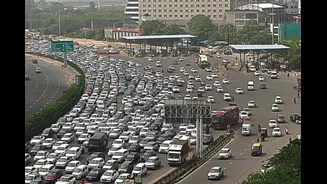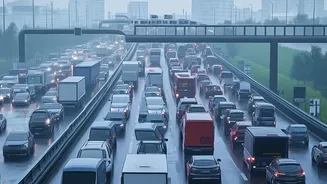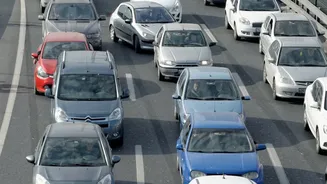



As winter's chill approaches, so does Delhi's familiar battle with smog. Starting November 1, the capital will enforce strict new vehicle entry regulations as part of its Winter Action Plan to combat hazardous air quality. Here’s what you need to know.
What Are the New Rules?
The primary regulation is a ban on vehicles registered outside of Delhi that do not meet Bharat Stage VI (BS-VI) emission standards. This restriction will be in effect from November 1, 2026, to January 31, 2027. It specifically targets older, more polluting petrol and diesel vehicles, including those with BS-III and BS-IV engines, from entering the city. The rules are part of Delhi's broader Winter Action Plan, which remains in force until February 28, 2027, and is designed to mitigate the severe air pollution that plagues the city annually. It is important to note that vehicles registered in Delhi are not covered by this specific entry restriction, though other age-based and pollution-related rules still apply to them.
Who Is Affected and Who Is Exempt?
The ban will primarily impact commuters and commercial vehicle operators from neighbouring NCR cities like Noida, Ghaziabad, Gurugram, and Faridabad who drive non-BS-VI vehicles into Delhi. Estimates suggest over a million vehicles from these areas could be affected. However, there are key exemptions. All electric vehicles (EVs) and vehicles running on compressed natural gas (CNG) are permitted to enter Delhi, regardless of their registration location. Additionally, vehicles providing essential and emergency services, such as ambulances and fire tenders, are also exempt. If your car is BS-VI compliant (generally those manufactured after April 2020), you are allowed entry, provided you have the correct documentation.
The 'No PUC, No Fuel' Mandate
Alongside the entry ban, a strict 'No PUC, No Fuel' policy will be enforced across Delhi. This means that fuel stations will deny petrol, diesel, or CNG to any vehicle that does not have a valid Pollution Under Control (PUC) certificate. This rule applies to all vehicles, including those registered in Delhi and those that are otherwise compliant with the entry rules, like BS-VI vehicles. Authorities will use Automatic Number Plate Recognition (ANPR) cameras at fuel pumps to verify PUC status in real-time. Driving without a valid PUC certificate can result in a hefty fine of up to ₹10,000.
Penalties and Enforcement
Enforcement of the new rules will be stringent. Authorities will set up checkpoints at Delhi's borders, using ANPR cameras to identify and stop non_compliant vehicles. While official penalty amounts for violating the entry ban are part of the Graded Response Action Plan (GRAP), past actions suggest significant fines. Under GRAP Stage III, driving a banned BS_III petrol or BS_IV diesel car can attract a challan of ₹20,000. In neighbouring Uttar Pradesh, the fine for a similar offence can be ₹5,000. These fines are separate from the penalty for not having a valid PUC certificate.
Other Anti_Pollution Measures
The vehicle restrictions are part of a multi_pronged approach. To discourage private vehicle use, parking fees at municipal_run facilities will be doubled from November 1, though parking at Delhi Metro stations will not be affected. Furthermore, a 50% work_from_home policy will be implemented for government and private offices to reduce commuter traffic, with staggered office timings to ease congestion. There will also be a ban on dust_generating construction and demolition activities during this period.