

India's Watchtower in Space
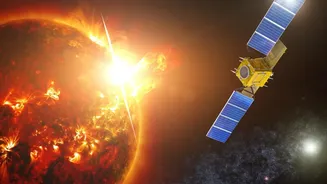
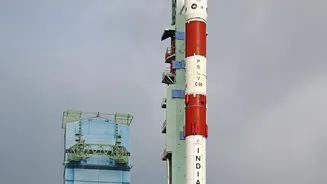
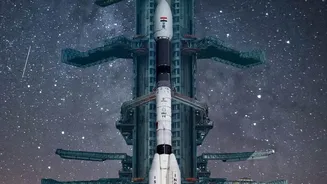
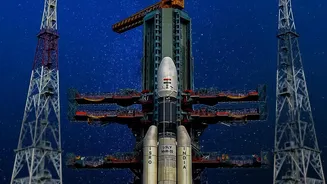
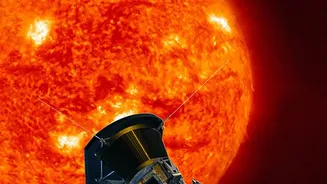
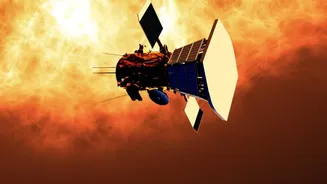
Launched by the Indian Space Research Organisation (ISRO), Aditya-L1 is the nation's first dedicated mission to study the Sun. It is strategically positioned at Lagrange Point 1 (L1), about 1.5 million kilometres from Earth. This unique vantage point
allows the spacecraft to watch the Sun continuously, without being blocked by our planet or the Moon. Its primary goal is to provide an early warning system for space weather—the volatile conditions in space driven by the Sun's activity. By monitoring solar flares and massive eruptions of plasma known as Coronal Mass Ejections (CMEs), Aditya-L1 aims to give us a crucial heads-up before these cosmic tempests reach Earth.
What Are Solar Storms?
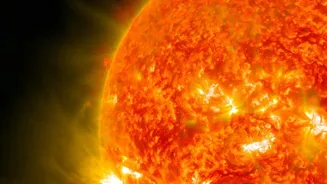
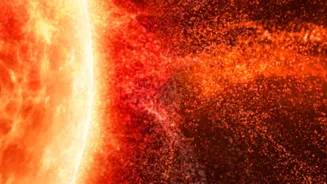
Think of solar storms as giant, energetic tantrums thrown by our Sun. They occur when the Sun's magnetic energy is suddenly released, hurling vast clouds of charged particles and radiation into space. If a CME is aimed at Earth, it can interact with our planet's magnetic field, or magnetosphere, which normally acts as a protective shield. A powerful storm can compress this shield, triggering geomagnetic storms that can have serious consequences. These events can disrupt satellite operations, interfere with GPS and communication signals, damage power grids on the ground, and pose a risk to astronauts in space. The beautiful auroras seen at the poles are a gentle reminder of this constant interaction.
The Breakthrough Coronal Data
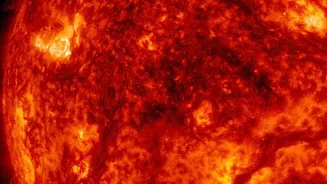
The latest excitement surrounds the data coming from Aditya-L1's key instruments, particularly the Visible Emission Line Coronagraph (VELC) and the Solar Ultraviolet Imaging Telescope (SUIT). The VELC is designed to study the Sun's outer atmosphere, the corona, which is where CMEs originate. By observing the corona in specific wavelengths of light, scientists can track the movement of solar material and analyse its properties like temperature and density. Recently, VELC data allowed researchers to precisely estimate the start time of a CME and observe how it was deflected by the Sun's magnetic fields. This ability to see a storm's initial trajectory is a game-changer for prediction. Meanwhile, the SUIT instrument is capturing the Sun's lower atmosphere in near-ultraviolet wavelengths never seen in such detail before, providing crucial information on the energy release that powers these eruptions.
From Better Data to Smarter Predictions
So, how does this new information help? It's all about lead time and accuracy. Previously, predicting the exact arrival time and impact of a CME was difficult. Now, with Aditya-L1's continuous stream of high-quality data, scientists can build more accurate models. Observations from VELC have helped identify the turbulent regions within a solar storm, which are often the most destructive. Understanding that turbulence, not just the bulk of the storm, drives the most severe geomagnetic chaos is a major leap forward. This allows for more specific warnings. Instead of just knowing a storm is coming, we can better forecast its strength and which of our technological systems are most at risk, giving operators of satellites and power grids more time to take protective measures.
Why This Matters for India
In an age where our economy and daily life depend on technology, vulnerability to space weather is a significant national concern. India has tens of thousands of crores worth of assets in space, from communication and navigation satellites to weather monitors. On the ground, our power grids, digital payment systems, and transportation networks are all reliant on stable satellite services and electricity. A severe solar storm could put all of this at risk. By becoming a key player in space weather forecasting, India is not just contributing to global science; it is building a shield of technological self-reliance. Aditya-L1's success strengthens our ability to protect critical infrastructure, ensuring that the nation's digital backbone remains secure against cosmic disturbances.