








A Black Hole in a Lab? Not Quite
First, let's be clear: scientists have not created a literal black hole in a laboratory. What researchers at the Advanced Science Research Center at the CUNY Graduate Center have done is replicate one of its most fascinating physical properties. More
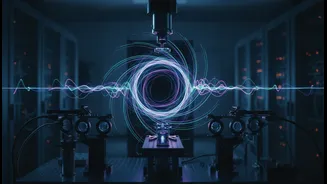
than 50 years ago, physicist Roger Penrose theorized that a rotating black hole could transfer some of its immense rotational energy to a particle or wave. This process, known as superradiance, means a wave could enter the chaotic region around a black hole and escape with more energy than it started with. Testing this has been impossible, as recreating the necessary rotational speeds on Earth would tear any known material apart. The breakthrough came from simulating the effect without any physical movement. Researchers built a stationary ring of electronic resonators and used precisely timed changes to their electrical properties, creating a moving pattern that mimics an object rotating at impossible speeds. This 'synthetic rotation' provides a safe and controllable way to study physics once confined to the cosmos.
The Science of Superradiance
The core principle at play is wave amplification, a phenomenon physicist Yakov Zel'dovich predicted could happen with any rotating object, not just black holes. Imagine skipping a stone across a still pond. Now, imagine that pond is a whirlpool. If you throw the stone in just the right way, it could be flung out by the whirlpool's motion, moving much faster than when it went in. Superradiance is the wave equivalent of this. The recent experiment confirmed this long-held theory. By sending radio waves with specific rotational properties into their stationary, synthetically rotating system, the scientists watched them emerge with more energy, amplified by drawing it from the simulated motion. This achievement turns a theoretical concept from astrophysics into a practical tool. It proves that energy can be extracted from a rotating system to boost a wave, a principle with profound implications for technology.
Enter Photonics: The Future of Electronics
This is where the connection to our future devices begins. For decades, technology has been driven by electronics, which use electrons to process and transmit information. Photonics is the next frontier, using particles of light—photons—to do the same job. You already interact with photonics daily through fiber-optic internet cables. The advantages are enormous: light is faster than electrons, can carry far more data, and consumes less power. As we push the limits of what silicon chips can do, photonics offers a path to faster computers, more efficient data centers, and smarter sensors. However, a key challenge in building photonic devices is efficiently amplifying light signals without generating excess heat or distortion. This is precisely the problem that black-hole-inspired wave amplification could solve.
Powering Tomorrow's Technology
The ability to selectively amplify waves using synthetic rotation could be a game-changer for photonic integrated circuits (PICs)—chips that run on light. This new method offers a way to boost light signals directly and efficiently. Potential applications are vast and could reshape entire industries. In telecommunications, it could lead to even faster and more reliable 5G and 6G networks. For artificial intelligence, light-based computing could process massive datasets with unprecedented speed and energy efficiency. In healthcare, more sensitive photonic biosensors could enable instant, on-the-spot diagnostics outside of a traditional lab. Even autonomous vehicles could benefit, with more affordable and powerful LiDAR systems that use light to 'see' the world around them. The CUNY experiment used radio waves, but the team plans to adapt the technology for light-based photonic and quantum systems, bringing these applications closer to reality.