





The Core Warning: A 'Slow-Moving Tsunami'
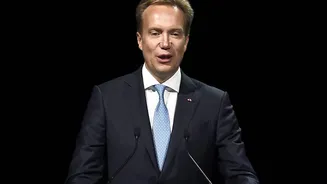
IMF Managing Director Kristalina Georgieva has described the impact of AI on the global workforce as a 'slow-moving tsunami'. Speaking ahead of and during the IMF and World Bank annual meetings in Bangkok, she stressed that the rapid evolution of AI is unlike
anything seen before. Her core message is that while AI promises immense productivity gains, these benefits are not guaranteed to be shared broadly. Without proactive policies and safeguards, Georgieva warns that the risks of AI—including widespread job displacement and increased inequality—could outweigh the opportunities. She argues that governments and institutions can no longer afford to delay action, urging policymakers to use the tools at their disposal to manage this profound economic transition.
A Double-Edged Sword for Jobs
The IMF's analysis presents a dual reality for the global labour market. The technology is expected to impact nearly 40% of jobs worldwide, with that figure rising to 60% in advanced economies. For roughly half of those affected, AI could complement their work, boosting productivity and potentially wages. For the other half, however, AI could execute tasks currently performed by humans, leading to lower demand for labour, reduced hiring, and downward pressure on wages. Georgieva has noted that middle-skilled jobs are particularly vulnerable to being squeezed, while those with AI-related skills see their earnings rise. This creates a divergence that threatens to hollow out the middle class and exacerbate social tensions if not addressed.
The Widening Inequality Gap
A primary concern for the IMF is that AI will worsen inequality, both within and between countries. Advanced economies, with their robust digital infrastructure and skilled workforces, are far better positioned to capture AI's benefits. In contrast, many developing nations lack the foundational requirements—such as reliable electricity, widespread internet access, and AI-ready education systems—risking being left further behind. This dynamic is already playing out, with the US and China accounting for the vast majority of investment and demand for AI-related equipment. Georgieva warns this concentration of power and prosperity could fuel global instability and erode social cohesion, making it a critical issue for international cooperation.
The Policy Toolkit for the AI Era
So, what should be done? Georgieva and the IMF have outlined a multi-pronged policy approach. First, governments must invest in resilient digital and energy infrastructure to support AI deployment. Second, a massive focus on education and retraining is needed to equip workers for the jobs of the future. Third, social safety nets must be strengthened to protect vulnerable workers displaced by automation. Georgieva also calls for 'guardrails'—a blend of industry self-regulation and government oversight to ensure AI develops safely and ethically. Furthermore, tax systems may need to be redesigned. As AI shifts the economy away from labour and toward capital, traditional income-based tax revenues could decline, requiring governments to find new sources to fund public services.
What It Means for India
As a major global player in the tech sector, India is frequently mentioned alongside the US and China as a country benefiting from the AI boom. The nation's strong IT services industry and growing pool of tech talent position it to capitalize on the AI transition. However, Georgieva's warnings about inequality and the need for infrastructure are highly relevant. Ensuring that the benefits of AI diffuse beyond the major tech hubs to the wider population will be a critical challenge. Policy will need to focus on expanding digital literacy, upgrading infrastructure across the country, and creating social support systems for workers in traditional sectors whose jobs may be at risk. The IMF's call for international cooperation on standards and regulation is also crucial for India to help shape the global rules of the road for this transformative technology.