





The world's insatiable demand for data is pushing cloud computing to its next frontier: space. But this leap in innovation, promising AI and data processing in orbit, comes with a serious warning that could forever change our view of the cosmos.
What Are Orbital Data Centres?
The concept
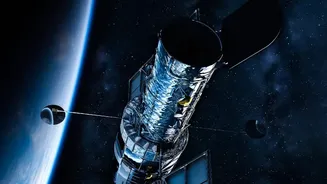
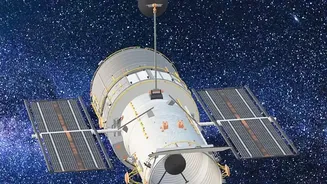
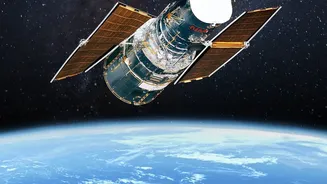
sounds like science fiction, but it's moving quickly toward reality. An orbital data centre (ODC) is essentially a computing and storage facility deployed in Low Earth Orbit (LEO). Instead of massive, power-hungry buildings on the ground, tech companies envision constellations of satellites working together as a distributed computing system. The driving force is the explosive growth of artificial intelligence and the immense energy and cooling demands of terrestrial data centres. By placing this infrastructure in space, companies hope to tap into uninterrupted solar power and overcome land and water constraints on Earth. Major players like Google, SpaceX, and Blue Origin are actively exploring concepts for these 'server farms in the sky', with some proposals suggesting initial deployments could happen as soon as 2027. The goal isn't just to process data from other satellites; it's to host general-purpose computing workloads, creating a new layer of the global cloud infrastructure that resides hundreds of kilometers above our heads.
A Sky Already Streaked with Light
The prospect of orbital data centres arrives when the night sky is already under threat. For years, astronomers have raised alarms about the impact of 'megaconstellations'—vast networks of satellites providing services like global internet. SpaceX's Starlink is the most prominent example, already accounting for more than half of the 15,000 active satellites in orbit. These satellites don't emit their own light, but their solar panels and chassis reflect sunlight, creating bright streaks that move across the sky, particularly in the hours after sunset and before dawn. For professional observatories, these trails can ruin long-exposure images, corrupting scientific data and rendering observations useless. The Vera Rubin Observatory, for instance, anticipates that up to 40% of its exposures could be polluted by these satellite trails. Even with mitigation efforts like non-reflective coatings and sun visors, the problem persists and, in some cases, has created new issues, like satellites scattering more blue light.
An Escalation of an Existing Problem
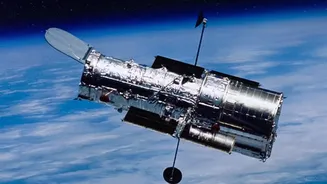
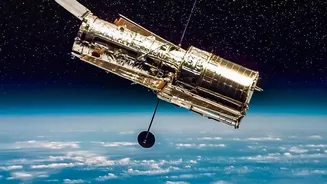
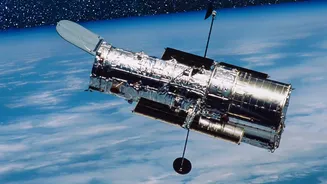
The data centre concept takes the light pollution problem to an entirely new scale. While existing constellations involve thousands of satellites, some proposals for orbital data centres are vastly more ambitious. One vision linked to SpaceX involves a staggering one million satellites. Scientists have modelled the potential impact, and the results are dire. One study found that such a constellation would leave an average of eight satellite trails on every long-exposure image taken at a leading observatory, with some parts of the sky showing more than 20 trails per image. Another analysis concluded that if constellations grow to just 56,000 satellites by the end of the decade, they could contaminate nearly 40% of images from the Hubble Space Telescope. The problem is not just the number of satellites, but their potential brightness. Some extremely bright designs could increase the background brightness of the night sky by 200-300%, turning areas currently designated as dark-sky sanctuaries into the equivalent of a light-polluted suburb.
The Search for a Workable Compromise
The astronomical community is not standing idly by. The International Astronomical Union (IAU) has created the Centre for the Protection of the Dark and Quiet Sky (CPS) to coordinate mitigation efforts. This has led to direct collaboration between scientists and satellite operators, including SpaceX, to find solutions. Mitigation techniques being tested include developing darker surface coatings, using dielectric mirrors to deflect sunlight, and deploying visors to block light from hitting the most reflective parts of a satellite. Another key recommendation is for satellites to operate at lower altitudes, which makes them dimmer and means they enter Earth's shadow sooner after sunset. However, no combination of these fixes can fully eliminate the impact if hundreds of thousands of new satellites are launched. As a result, astronomers and science academies are calling for greater regulation and the establishment of an international governing body to manage the issue before the sky is irrevocably altered.