


Cosmic Time Machines
Imagine receiving a photograph of a grandparent as a toddler who is already six feet tall. That’s the kind of baffling situation astronomers now face. Thanks to the James Webb Space Telescope (JWST), scientists are discovering quasars—incredibly bright
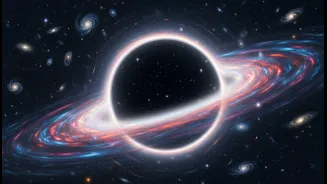
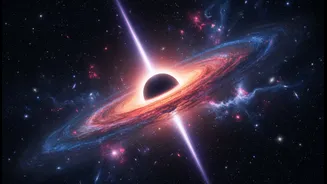
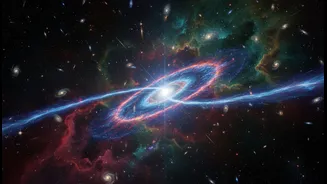
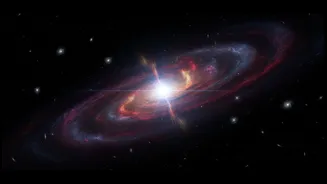
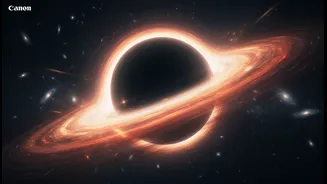
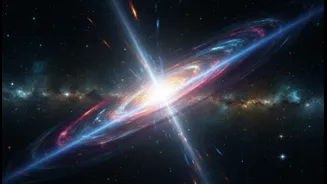
objects powered by supermassive black holes—at record-breaking distances. Because light takes time to travel, looking at these distant objects is like looking back in time. Recent discoveries, such as a quasar named JADES-GS-z14-0, are being seen as they were when the universe was only a few hundred million years old, a mere fraction of its current age. These aren’t just any black holes; they are behemoths, some weighing millions or even billions of times the mass of our sun.
The Billion-Sun Paradox
Herein lies the mystery. According to our best theories, black holes need time to grow. They start small, perhaps from the collapse of a massive star, and grow by steadily consuming gas, dust, and other stars, or by merging with other black holes. This process is like a slow-motion feast that unfolds over billions of years. Yet, the newly discovered quasars host black holes that reached monstrous sizes when the universe was in its infancy. They are far too large for the time that was available for them to grow. It’s a cosmic conundrum: how did these giants get so big, so fast? The observations defy the expected growth limits, forcing a major rethink of how the first cosmic titans were born.
Challenging the Standard Theories
For years, scientists have worked with two main ideas for how supermassive black holes get their start. One is that they begin as “light seeds”—black holes left over from the death of the first massive stars, weighing maybe 100 times our sun. The other is the “heavy seed” or “direct collapse” model, where a gigantic cloud of primordial gas collapses directly into a black hole of thousands of solar masses, skipping the star phase entirely. But even the heavy seed model struggles to explain these new findings. Some of these ancient black holes appear to be more massive than their entire host galaxy, flipping the script on whether the galaxy or the black hole comes first. Discoveries of some quasars appearing surprisingly lonely, without the expected dense galactic neighborhood to feed on, only add to the puzzle.
The Search for New Answers
The existence of these impossibly large, early black holes has sent theorists back to the drawing board. Is there a way for black holes to grow much faster than we thought, perhaps through a process of “super-Eddington” accretion where they binge-eat gas at an extreme rate? Or do these discoveries point to something more exotic? Some scientists are now exploring radical new ideas. One proposal involves a new role for dark matter, suggesting that the decay or interaction of these mysterious particles could have helped seed the first massive black holes. Another possibility is that the seeds were primordial black holes, formed not from stars but from density fluctuations in the first seconds after the Big Bang itself.