

Unpacking the Cosmic Time Warp
Let’s start with the basics. For any planet, a “year” is the time it takes to complete one orbit around the sun. An Earth year is about 365 days. A “day,” however, refers to the time it takes for a planet to complete one full rotation on its own axis.
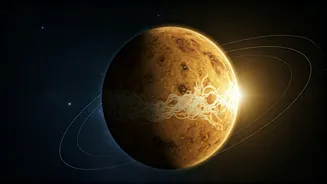
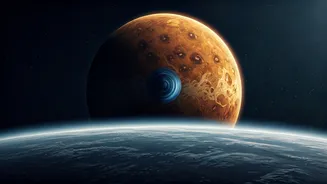
The headline’s shocking claim hinges on this distinction. On Venus, these two timeframes are completely out of whack compared to what we’re used to. It zips around the sun relatively quickly, completing its year in about 225 Earth days. But its rotation is agonizingly slow. In fact, it’s the slowest of any planet in our solar system.
Venus's Bizarre Calendar
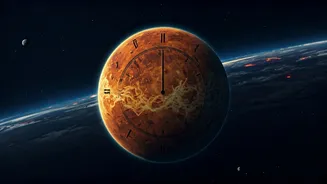
Here are the mind-bending numbers. A single rotation of Venus on its axis—what astronomers call a sidereal day—takes 243 Earth days. That’s right, one full spin of the planet takes longer than its entire journey around the sun (225 Earth days). So, if you were standing on Venus, a single day (one rotation) would literally last longer than a Venusian year. This is the core of the paradox. It’s a place where you could celebrate your first birthday before you’ve even lived through your first full day. It’s an idea so alien it’s hard to grasp, but it’s the fundamental reality of our planetary neighbor.
But What About Sunrise to Sunrise?
To make things even weirder, Venus spins backward. Unlike Earth and most other planets, it has a retrograde rotation, meaning the sun rises in the west and sets in the east. This backward spin, combined with its orbital motion, creates another strange timekeeping quirk. While a full rotation takes 243 Earth days, the time from one sunrise to the next—a solar day—is significantly shorter, clocking in at about 117 Earth days. So while a Venusian day is technically longer than its year, the experience of daylight and darkness would cycle twice per orbit. You'd get two sunrises for every one birthday, though each period of 'daylight' would last for nearly two Earth months.
A Day You Wouldn't Want to Experience
Before you get jealous of those long, lazy days, let's be clear: a day on Venus would be an absolute nightmare. This isn’t a tropical paradise with long sunsets. Our “sister planet” is more like an evil twin. The atmosphere is about 96% carbon dioxide, creating a runaway greenhouse effect that sends surface temperatures soaring to an average of 864°F (462°C). That’s hot enough to melt lead. The atmospheric pressure on the surface is over 90 times that of Earth, equivalent to being more than half a mile deep in the ocean. And instead of water clouds, Venus is shrouded in thick, toxic clouds of sulfuric acid. So, while the slow day is a fascinating celestial curiosity, it’s unfolding in one of the most inhospitable environments imaginable.
Why Is Venus So Weird?
Scientists are still debating why Venus ended up this way. Its slow, backward rotation is a major puzzle. One leading theory suggests it was struck by a massive asteroid or planetoid early in its history, which sent it spinning in the opposite direction and slowed its rotation to a crawl. Another hypothesis proposes that the powerful gravitational pull of its incredibly thick atmosphere, dragging against the planet’s surface, acted as a brake over billions of years. Whatever the cause, Venus serves as a powerful reminder of how planetary evolution can take drastically different paths, turning a world roughly the same size as Earth into a scorching, high-pressure hellscape with a day longer than its year.