




When we look at the night sky, it's easy to feel small. But the words we use to describe that vastness—like 'solar system' and 'galaxy'—are often confused. While related, they describe cosmic structures on unimaginably different scales.
The Local Neighbourhood: What Is a Solar System?
Think of a solar
system as a single household built around a central star. Our home, the Solar System, consists of our star—the Sun—and everything gravitationally bound to it. This includes the eight planets (Mercury, Venus, Earth, Mars, Jupiter, Saturn, Uranus, and Neptune), hundreds of moons, and countless smaller objects like asteroids, comets, and dwarf planets such as Pluto. The Sun is the undisputed head of this household, containing over 99.8% of the entire system's mass. Its immense gravity is the force that keeps all the planets in their orbits, from Mercury's quick 88-day trip to Neptune's distant 165-year journey. While our Solar System feels vast to us, it's just one of countless such systems in the cosmos.
The Sprawling City: What Is a Galaxy?
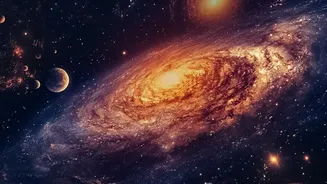
If a solar system is a single house, then a galaxy is a massive, sprawling city containing billions of houses. A galaxy is an enormous collection of gas, dust, dark matter, and billions of stars, each of which may have its own planetary system. Our solar system is located within a galaxy called the Milky Way. The Milky Way is a spiral galaxy estimated to contain between 100 billion and 400 billion stars. Like a city, galaxies have different structures. Some are spiral-shaped like ours, with a bright central bulge and arms curving outwards. Others are smooth and elliptical, or have no defined shape at all and are called irregular galaxies. Most large galaxies, including our own, are believed to have a supermassive black hole at their center.
A Question of Scale
The single biggest difference between a solar system and a galaxy is scale. To put it in perspective, light takes about eight minutes to travel from the Sun to Earth. To cross our entire Solar System to the edge of the Kuiper Belt, it could take hours. To cross the Milky Way galaxy, however, that same beam of light would need to travel for about 100,000 years. An analogy from NASA helps to grasp this: if you were to shrink our Solar System down to the size of your hand, the Milky Way galaxy would be as large as the entire North American continent. Our Sun is just one average-sized star among the hundreds of billions in our galaxy, and our entire solar system is located in one of its spiral arms, about halfway from the galactic center.
The Force That Binds
Both solar systems and galaxies are held together by gravity, but it works in different ways. In a solar system, the gravity of a single, dominant object—the central star—governs the orbits of everything else. In a galaxy, the dynamic is much more complex. While a supermassive black hole often sits at the center, its mass is a tiny fraction of the galaxy's total. Instead, a galaxy is held together by the combined gravitational pull of all its stars, gas, and dust. Furthermore, scientists believe there is an invisible component called 'dark matter' that provides the extra gravitational glue needed to keep galaxies from flying apart as they spin. This mysterious substance is thought to make up a significant portion of a galaxy's total mass.