





A Legend Fed by the Sea
The story of the Seven Pagodas of Mahabalipuram is a powerful one that has been passed down through generations. European sailors from centuries ago wrote of seeing the glittering tops of several temples from the sea, a sight that gave the port town its
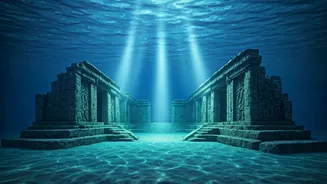
famous nickname. Local lore, meanwhile, speaks of a jealous god who submerged a glorious city, leaving only the solitary Shore Temple as a testament to what was lost. For a long time, these were just stories. But fishermen occasionally claimed to glimpse man-made structures beneath the waves, and a dramatic event in 2004 brought the legend roaring back to life. When the Indian Ocean tsunami struck, the sea briefly receded by up to 500 metres, exposing long rows of large, carved stones before the waves crashed back over them. This fleeting glimpse provided a tantalising clue that there was indeed something substantial hidden beneath the water.
The Modern Quest Begins
The 2004 tsunami acted as a catalyst, transforming popular legend into a subject of intense scientific inquiry. The Archaeological Survey of India (ASI) and India's National Institute of Oceanography (NIO) launched joint expeditions to systematically investigate the area. This wasn't a treasure hunt, but a scientific mission to map and understand a potential submerged heritage site. Early explorations after the tsunami, conducted with the help of the Indian Navy, confirmed that the rows of stones seen during the event were part of long, man-made walls. These initial findings were groundbreaking, suggesting that the Pallava-era complex was far larger than the monuments visible on land today.
Seeing with Sound: The Technology of Discovery
So how do you ‘see’ a city buried under sand and sea? The primary tool is sound. Scientists employ high-tech equipment like side-scan sonar and multibeam echosounders. These instruments are typically towed behind a boat and emit acoustic pulses—pings of sound—towards the seabed. These sound waves bounce off objects and return to the device. By measuring the time it takes for the echo to return and its strength, the system creates a detailed image of the seafloor's topography. Hard objects like stone walls reflect sound differently than soft sand, allowing researchers to distinguish potential man-made structures from the natural environment. It’s a way of painting a picture of what lies beneath without any physical digging, a process crucial for preserving fragile underwater sites.
From Data to Digital Reconstruction
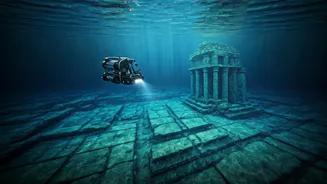
The raw data from sonar scans is a collection of acoustic signals, not a clear photograph. The next step is where visualisation truly begins. This data is processed by powerful computers to generate high-resolution, three-dimensional models of the seabed. More recently, teams have started using Remotely Operated Vehicles (ROVs) equipped with high-resolution cameras. These ROVs can get closer to the structures, capturing detailed imagery and videos that can be stitched together using a technique called photogrammetry. This process creates precise 3D point clouds, essentially a digital replica of the ruins. By integrating this data into real-time rendering engines, like those used in video games, archaeologists can virtually fly through the submerged site, examining walls, steps, and scattered blocks from any angle.
What the Visualisations Reveal
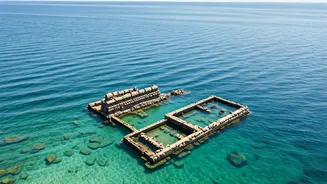
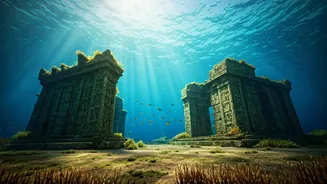
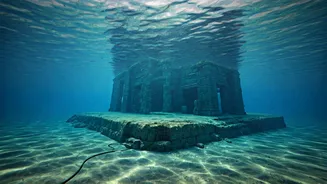
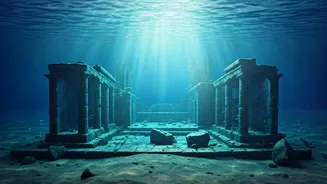
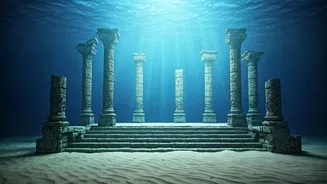
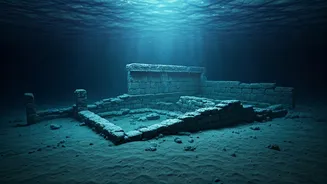
The efforts have yielded remarkable results. Explorations have confirmed the existence of submerged walls, platforms, and flights of stairs at depths ranging from 3 to 9 metres. These structures are located up to 800 metres from the current shoreline. The layout of some of these submerged ruins appears to align with the existing Shore Temple, suggesting they were once part of a single, vast complex. While thick marine growth often obscures details, the shapes and arrangements are unmistakably man-made. Radiocarbon dating of marine growth on the stones suggests different parts of the site were submerged at different times, with some structures going under as early as the 1st century CE and others in the 14th century, long after the Pallava dynasty.