

A Faint Signal, A Great Relief
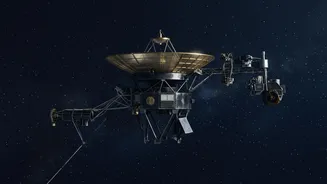
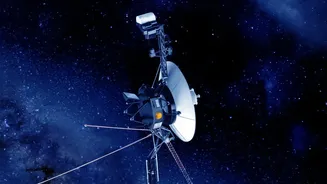
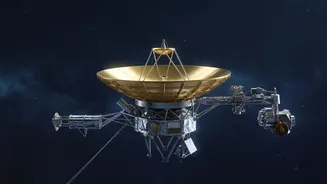
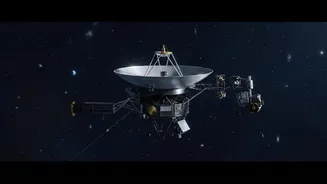
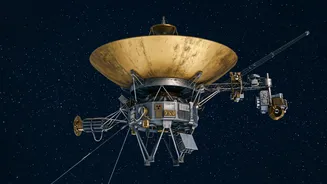
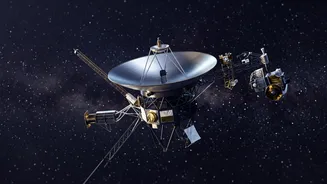
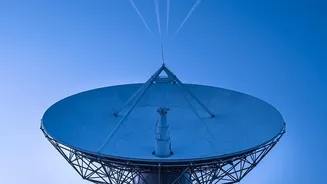
For 48 tense hours in October, NASA’s Deep Space Network strained to hear a whisper from Voyager 1 and heard nothing. On two scheduled check-ins, the pioneering spacecraft, now nearly 26 billion kilometers from home, was silent. Then, on October 20, before
engineers could even send troubleshooting commands, the signal returned. An investigation revealed that the probe’s onboard computer had automatically detected a problem with its primary thrusters, switched to its backup set, and placed itself into a stable 'safe mode', temporarily pausing communications as a precaution. This autonomous recovery by a 49-year-old computer billions of kilometers away is a testament to its robust design, but also a reminder that, as one mission manager noted, we must now 'expect the unexpected'.
The One-Light-Day Milestone
The brief scare comes just weeks before Voyager 1 achieves a record that belongs entirely to the strange physics of deep space. On November 18, 2026, the spacecraft will become the first human-made object to be one light-day distant from Earth. This means that a radio signal, traveling at the fastest speed possible, will take a full 24 hours to reach it. A round-trip communication—asking the probe a question and receiving its reply—will take a minimum of 48 hours. This isn't a physical boundary, but a communications horizon that fundamentally changes how we interact with our most distant emissary. For mission controllers, it's like sending a text on Monday and getting the reply on Wednesday.
A Grand Tour That Never Ended
Launched in 1977, Voyager 1 and its twin, Voyager 2, were initially designed for a four-year 'Grand Tour' of the outer planets. What they accomplished was legendary. Voyager 1 discovered active volcanoes on Jupiter's moon Io and gave us our first detailed look at Saturn's complex ring system. A flyby of Saturn's moon Titan then flung it on a trajectory out of the plane of the solar system and toward the stars. In 1990, it turned its camera back one last time to capture the iconic 'Pale Blue Dot' image, showing Earth as a tiny speck in the vastness of space. Then, in 2012, it became the first human object to cross the heliopause, the boundary where the Sun's influence ends and interstellar space begins.
Keeping a Legend Alive
Keeping a nearly 50 year old spacecraft running is an exercise in creative problem solving. Voyager 1 is powered by the heat from decaying plutonium, a source that diminishes by about four watts each year. To conserve power, engineers have been methodically shutting down instruments. In a recent move nicknamed the 'Big Bang', the team simultaneously swapped three heating units for more energy efficient alternatives to extend the life of the remaining science instruments. Previous issues, like a corrupted memory chip that garbled data for five months starting in late 2023, required engineers to cleverly rewrite and relocate software code from 24 billion kilometers away. Each fix is a race against dwindling power and aging electronics.
A Message in a Bottle
Voyager $^$1$'s journey is now measured in centuries. In about $^$300 years$, it will reach the inner edge of the Oort Cloud$, a vast$, theoretical sphere of icy bodies surrounding our solar system. It will take an estimated $^$30$,$000 years to cross it. Its next close encounter will be in about $^$40$,$000 years$, when it will pass within $^$1$.$6 light-$^$years of the star Gliese $^$445$. Affixed to its side is the Golden Record$, a gold-$^$plated copper disc containing sounds and images selected to portray the diversity of life and culture on Earth. It carries greetings in $^$55 languages$, music from Bach to Chuck Berry$, and $^$115 images$, a message in a bottle cast into the cosmic ocean$, destined to long outlive the civilization that created it.