








A Museum with No Walls
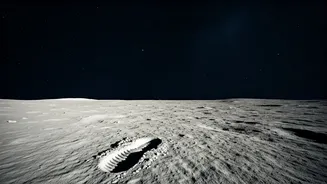
When Neil Armstrong and Buzz Aldrin stepped onto the lunar surface in 1969, they weren't just walking; they were engraving history into a cosmic stone tablet. The Moon has no atmosphere, which means it has no wind to blow dust around and no rain to wash
away impressions. The footprints left by the 12 astronauts who walked on the Moon are still there today, looking almost as fresh as the day they were made. Alongside them lie the rover tracks, discarded equipment, and other artifacts from the Apollo missions. The entire landing site is a pristine, silent museum, preserved not by glass cases but by the vacuum of space itself.
The Science of Stillness
The key to this incredible preservation is the Moon’s geological and atmospheric inactivity. On Earth, erosion is a relentless force. Wind, water, and ice constantly sculpt our planet’s surface. A footprint on a sandy beach might last for minutes, while one in mud could survive for days or weeks before being weathered away. Even our oldest stone structures, like the pyramids of Giza or the Roman Colosseum, show the scars of millennia of wind and rain. Our planet is dynamic and alive, constantly recycling its own surface through plate tectonics, volcanic activity, and the endless churn of weather. The Moon, in stark contrast, is largely a dead world. It has no liquid water, no protective atmosphere, and its geological engine cooled down billions of years ago. This stillness is what makes it an unparalleled archivist.
The Slowest Form of Erosion
This isn't to say the footprints will last forever, but their lifespan is measured in millions of years, not days or centuries. The only significant erosional forces on the Moon are the relentless bombardment of micrometeorites and the charged particles of the solar wind. Micrometeorites, tiny particles of cosmic dust no bigger than a grain of sand, constantly pepper the lunar surface. Over immense timescales, this gentle 'sandblasting' effect will gradually smooth over the sharp edges of the footprints, eventually erasing them. Scientists estimate this process is so slow that the footprints could remain visible for anywhere from 10 million to 100 million years. They will exist long after the civilizations that created them are gone, a silent testament to a time when humans first stepped off their home world.
A Legacy Etched in Dust
The longevity of these lunar footprints forces a profound change in perspective. On Earth, our legacy is measured in stories, ideas, and the crumbling ruins of empires. Here, nature reclaims everything. Forests grow over abandoned cities, rivers change course, and mountains rise and fall over geological time. We are temporary residents on a planet defined by change. But on the Moon, our physical trace is shockingly permanent. Those simple boot prints, made in a few hours of exploration over fifty years ago, will outlast every skyscraper, every road, and every monument currently on Earth. They are a message in a cosmic bottle, a fossil from the distant past for some hypothetical future observer. They tell a story not just of a journey to another world, but of the fundamental difference between our dynamic, living planet and the silent, static satellite that orbits it.