







The Illusion We All Experience
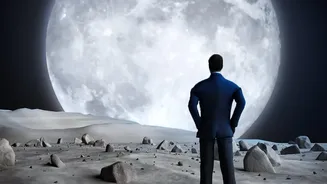
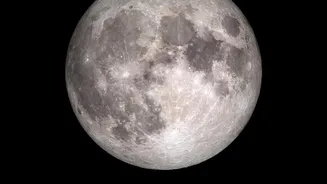
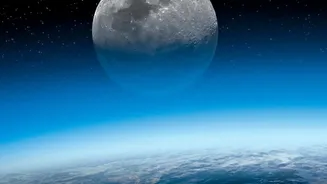
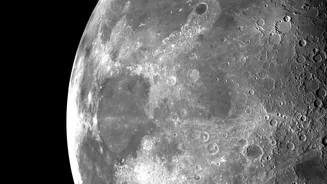
This phenomenon, known as the Moon illusion, has captivated and puzzled humanity for centuries, with records of it dating back to ancient Greece. The first thing to know is that your eyes are not deceiving you, but your brain is. Despite what it looks
like, the Moon is not physically larger on the horizon. In fact, due to the physics of your viewing angle, the horizon Moon is technically about 1.5% farther away from you than the zenith Moon (the one directly overhead), and therefore should appear slightly smaller. Photographs confirm this; if you take a picture of the horizon Moon and the zenith Moon with the same lens, they will measure the same size. The change in size is a powerful and consistent trick of the mind.
Your Brain Is the Director
The illusion isn't caused by the Earth's atmosphere acting as a magnifying glass, a common misconception. Any atmospheric distortion would actually make the Moon appear slightly smaller, not larger. The real magic happens inside your head. Your brain constantly interprets visual signals to build a coherent picture of the world. It uses past experience and environmental cues to make judgments about size, distance, and perspective. The Moon illusion is a fascinating side effect of this normally helpful process.
The Apparent Distance Hypothesis
The most widely accepted explanation is the 'apparent distance hypothesis'. This theory suggests our brains perceive the sky as a flattened dome, not a perfect hemisphere. When the Moon is on the horizon, your brain sees a landscape filled with distance cues: trees, buildings, and mountains. It knows these objects are far away. Because the Moon appears 'behind' these objects, your brain assumes it must be extremely far away. In contrast, when the Moon is high in the empty sky, there are no intervening objects to give you a sense of scale. With no reference points, your brain perceives the overhead sky as being much 'closer'.
The Ponzo Illusion Parallel
This leads to the crucial part of the illusion, which can be explained by the classic Ponzo illusion. Imagine two identical lines drawn on a picture of converging railway tracks. The line drawn on the 'farther' part of the tracks will appear larger than the one on the 'closer' part, even though they are the same length. Your brain applies a rule called 'size constancy': if two objects cast the same-sized image on your retina, but one appears to be farther away, the farther one must be physically larger. The same logic applies to the Moon. The horizon Moon and zenith Moon take up the same amount of space on your retina, but because your brain judges the horizon to be farther away, it scales up the horizon Moon, making it look enormous.
The Cardboard Tube Solution
This brings us to the humble cardboard tube. When you look at the giant horizon Moon through a tube, you are performing an act of 'visual context deprivation'. The tube blocks your view of the surrounding landscape—the trees, buildings, and other distance cues. By isolating the Moon from its environment, you remove the information your brain was using to make its 'far away' judgment. Stripped of this context, the brain no longer applies the size-constancy scaling. The illusion breaks, and the Moon shrinks back to its 'normal' perceived size, the same size it appears when high in the sky.