



From Sight to Sound
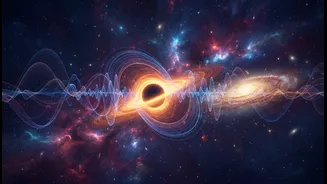
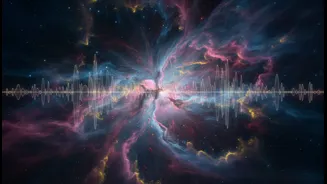
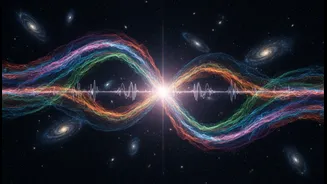
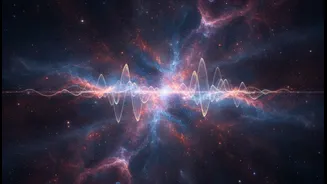
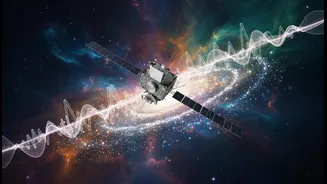
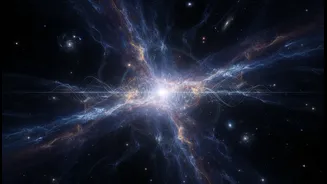
Space is a vacuum, meaning sound waves have nothing to travel through. So, the audio you might have heard from NASA isn't a recording from a microphone placed next to a black hole. Instead, it’s the result of a process called data sonification. Scientists
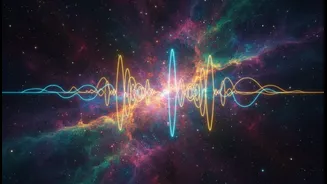
take the vast amounts of data collected by telescopes like the Chandra X-ray Observatory and the James Webb Space Telescope—information about light, energy, and density that we usually see as stunning images—and translate it into sound. Think of it like a musician reading sheet music; in this case, the cosmic data points are the notes. Different elements of an image, such as brightness, colour, or position, are assigned specific pitches, volumes, and tones. A bright star might become a high, loud note, while a dense gas cloud could be a low, sustained hum.
The Art of Cosmic Composition
Creating space audio is both a science and an art. Scientists, musicians, and visualization experts collaborate to decide how to map data to sound in a way that is both accurate and intuitive. For instance, in the famous sonification of the Crab Nebula, data from different telescopes were assigned to different instrument families. X-rays from Chandra were represented by brass instruments, visible light from Hubble became strings, and infrared data from the Spitzer telescope were played by woodwinds. The result is a symphony where listeners can hear the interplay between different layers of cosmic information. Similarly, for the Pillars of Creation, the eerie, ethereal sounds help us experience the star-forming region in a completely new dimension.
A New Tool for Discovery
While sonification is a powerful tool for public engagement, it also has serious scientific applications. The human ear is exceptionally good at detecting patterns, sometimes even better than the eye. By listening to data, researchers can identify subtle variations, anomalies, or rhythms that might be missed in a purely visual analysis. This is particularly useful in fields like asteroseismology—the study of stellar vibrations—or when searching for faint signals in noisy datasets. It adds another powerful tool to the astronomer's toolkit, allowing them to explore complex data in a multi-sensory way and potentially leading to new discoveries.
Making the Universe Accessible to All
Perhaps the most profound impact of space audio is its role in making astronomy more inclusive. For people who are blind or have low vision, astronomy has traditionally been a very challenging field to access. Sonification changes that entirely. It provides a direct way for visually impaired individuals to experience and study the wonders of the cosmos, turning abstract concepts into tangible, audible experiences. Projects from NASA and other organisations are now developed in partnership with members of the blind and low-vision community to ensure the sounds are meaningful and useful. This not only opens doors for a new generation of scientists but ensures that the universe truly is for everyone.
Where You Can Listen
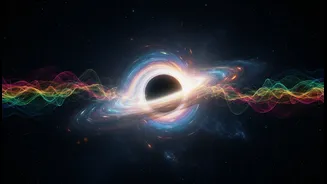
Curious to hear it for yourself? NASA has made a wealth of sonified data available to the public through its "Universe of Sound" project. You can listen to the ominous pressure waves of a black hole in the Perseus galaxy cluster, the delicate chimes of the galaxy Centaurus A, or the dramatic sweep of a supernova remnant. These soundscapes offer more than just a novel experience; they represent a fundamental shift in how we connect with the cosmos. They transform silent, distant objects into an intimate, emotional, and deeply human experience.