






More Than Just Northern Lights
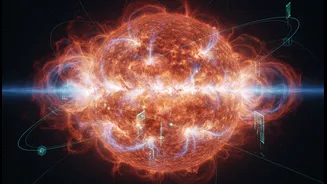
So, what exactly is space weather? Unlike the weather in our atmosphere, it doesn't involve rain or wind in the traditional sense. Instead, it refers to the changing conditions in space driven by the Sun's activity. Our star is constantly sending out
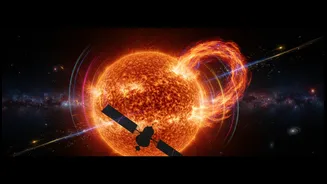
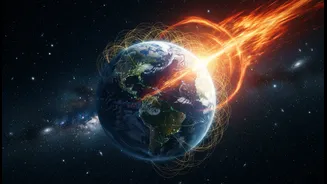
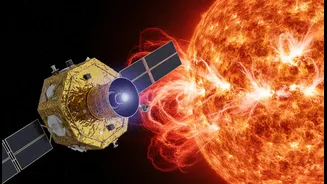
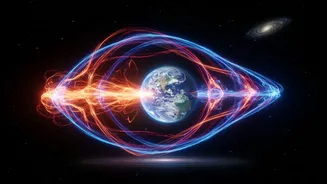
a stream of charged particles called the solar wind. Sometimes, it unleashes more dramatic events like solar flares (immense bursts of radiation) or coronal mass ejections (CMEs), which are giant clouds of plasma and magnetic fields hurled into space. When these phenomena interact with Earth’s magnetic field, they can create beautiful auroras. But these beautiful lights are a sign of intense energy hitting our planet, with consequences that go far beyond a pretty sky.
Our Modern World Is Vulnerable
Our dependency on technology makes us increasingly susceptible to the effects of space weather. A severe solar storm could have a major impact on critical infrastructure. Geomagnetic storms can induce extra currents in power grids, potentially causing widespread blackouts. Satellites, which are essential for everything from GPS navigation and telecommunications to weather forecasting on Earth, can be damaged or have their orbits altered. This disrupts aviation, maritime shipping, and even financial transactions that rely on precise timing from GPS. Furthermore, the increased radiation from solar storms poses a health risk to astronauts and even airline passengers and crew on polar routes.
The New Generation of Forecasters
This is where space weather professionals come in. Their primary job is to monitor the Sun and forecast its activity to provide warnings. Like terrestrial weather forecasters, they analyse data from a host of ground-based and satellite observatories to predict when a solar storm might hit Earth and how severe it might be. These jobs include space weather analysts, space physicists, and heliophysicists. Their work is crucial for giving industries time to take protective measures, such as rerouting flights, temporarily taking power grids offline, or moving satellites into safer orbital positions. It’s a field that combines physics, data analysis, and problem-solving to safeguard our technological society.
A Universe of Career Opportunities
The demand for space weather experts is growing in both the public and private sectors. Government agencies like ISRO in India and NOAA in the US are major employers, running prediction centres and conducting research. India, through institutions like the Center of Excellence in Space Sciences India (CESSI) at IISER Kolkata, is actively developing its space weather forecasting capabilities, especially with missions like Aditya-L1. The private sector is also booming. Commercial satellite operators, airlines, and even insurance and financial companies need space weather expertise to assess and mitigate risk. This creates a wide range of roles, from scientific programmers and systems engineers to data analysts and research scientists.
Your Pathway into the Field
A career in space weather typically begins with a strong foundation in science and maths. A bachelor's degree in physics, atmospheric science, astronomy, geophysics, or a related engineering field is a common starting point. Many of the more specialized roles in research and forecasting require a Master’s degree or a PhD. For students in India, institutions like the Indian Institutes of Science Education and Research (IISERs), the Indian Institute of Astrophysics (IIA), and the Physical Research Laboratory (PRL) are central to space science research. Developing skills in computer programming, data analysis, and machine learning is also highly desirable, as modern forecasting relies heavily on computational models.