


A Decagon in the Making
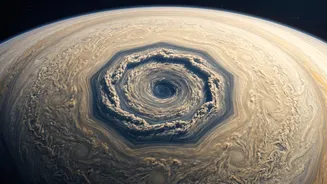
Recent images captured by NASA's Hubble Space Telescope have revealed a colossal, 10-sided atmospheric wave, or decagon, encircling Saturn's south pole. This is the first time scientists have ever observed such a large, regular-sided jet pattern in the planet's
southern hemisphere. The discovery was made possible by the Outer Planet Atmospheres Legacy (OPAL) program, which uses Hubble to take annual snapshots of our solar system's gas giants to monitor their long-term weather patterns. By reviewing data stretching back to 2023, scientists realised they were watching the feature evolve, strengthening from faint hints into a more clearly defined structure. This gives researchers a rare opportunity to watch a planetary-scale weather system being born.
Not A Mirror Image
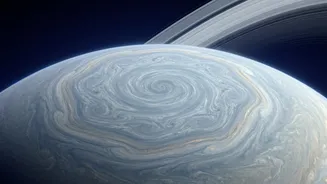
For decades, scientists have been captivated by Saturn's north pole, which hosts a massive, stable, six-sided jet stream known as the hexagon. This feature has been observed for more than 40 years. Researchers had long wondered if a similar structure might exist at the south pole. While this new decagon is a geometric counterpart, it's not an identical twin. The northern hexagon is a long-lived, stable feature, whereas the southern decagon appears to be a recent and still-developing phenomenon. NASA's Cassini spacecraft, which orbited Saturn from 2004 to 2017, saw no signs of this 10-sided structure, confirming its recent formation. This suggests different atmospheric dynamics might be at play at each pole.
A Change of Seasons
The discovery was made possible thanks to Saturn's long, slow change of seasons. A year on Saturn lasts for nearly 30 Earth years, meaning each season is over seven years long. For more than a decade, the planet's south pole was tilted away from Earth, hidden in the darkness of its own long winter. As the pole has gradually tilted back toward us, moving into its spring and summer, sunlight has returned, and telescopes like Hubble can get a clear view. Scientists believe the seasonal warming is the key driver behind this new atmospheric pattern, providing the energy to stir up the atmosphere and form this massive wave. The collaboration of professional and amateur astronomers was crucial, as ground-based observers first spotted faint anomalies in 2024 that hinted at the decagon's existence.
A Natural Laboratory
This evolving decagon is more than just a beautiful pattern; it's a natural laboratory for understanding how atmospheres work on gas giants. The structure isn't just a surface-level cloud feature; it extends deep into the planet's atmosphere through multiple layers. By studying how this 10-sided wave forms and changes, scientists can refine their models of planetary weather. They hope to learn why these geometric shapes form in the first place, what powers them, and whether the southern decagon will eventually stabilise into a long-lasting feature like the northern hexagon or dissipate over time. Continued observations will help solve this latest mystery, offering insights that could even apply to atmospheric dynamics here on Earth.