



The Universe's Hidden Skeleton
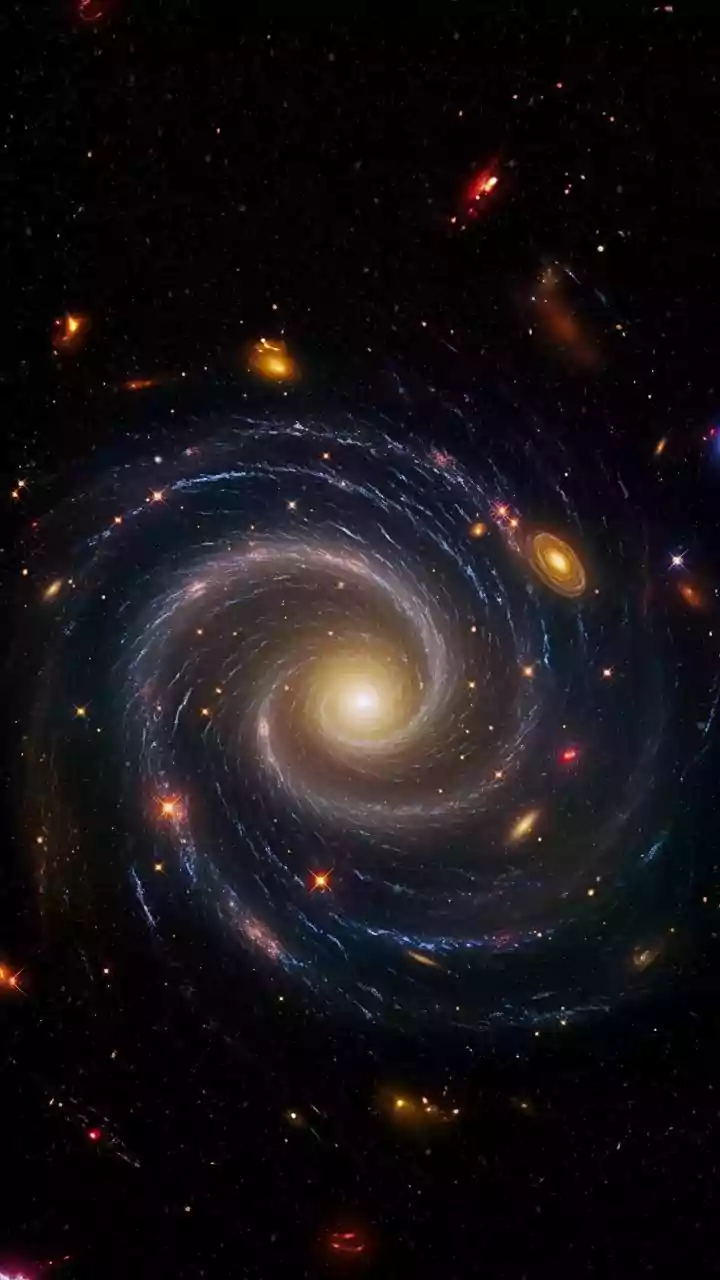
Galaxies aren't scattered randomly across space like marbles dropped on a floor. They are organized into an immense and intricate pattern known as the cosmic web. This web consists of long, thin filaments of galaxies and gas stretching across millions
of light-years, connecting dense hubs called clusters. Between these filaments lie enormous, nearly empty regions called voids. This 'large-scale structure' is the framework of the cosmos, shaped by gravity acting on tiny density fluctuations from the early universe. Mapping this web is crucial for understanding some of the biggest questions in physics, including the nature of the mysterious dark energy that is causing the universe's expansion to accelerate. By charting this structure, scientists can test their models of how the universe began and how it will evolve.
Hydrogen: The Universe's Ultimate Tracer
To map this invisible structure, astronomers need a tracer—something that is abundant everywhere and follows the distribution of matter, including the elusive dark matter that makes up the bulk of the web. The perfect candidate is neutral hydrogen, the simplest and most common element in the universe. Neutral hydrogen atoms occasionally emit a faint radio signal with a specific wavelength of 21 centimetres. This signal is incredibly weak, but it comes from nearly everywhere. Because the universe is expanding, this 21cm wavelength gets stretched out as it travels across billions of years to reach us. By measuring how much the wavelength has stretched (its 'redshift'), astronomers can calculate the signal's distance, allowing them to build a 3D map.
Introducing CHIME: A Telescope Like No Other
Enter the Canadian Hydrogen Intensity Mapping Experiment, or CHIME. Located in British Columbia, Canada, CHIME doesn't look like a traditional dish telescope. Instead, it consists of four massive, stationary U-shaped troughs, each the size of a professional snowboarding half-pipe. With no moving parts, it scans huge portions of the sky every day as the Earth rotates. CHIME was specifically designed to detect the faint, redshifted 21cm signals from neutral hydrogen. Its goal is ambitious: to create the largest-volume 3D map of the universe ever made, charting its structure when the cosmos was between 2.5 and 7 billion years old—a key period when dark energy began to dominate.
Painting with a Broad Brush: Intensity Mapping
Traditional galaxy surveys are like trying to map a country by locating every single house—a slow and painstaking process. CHIME uses a more efficient technique called Hydrogen Intensity Mapping. Instead of trying to pinpoint individual, faint galaxies, it measures the collective, smeared-out glow of hydrogen from enormous volumes of space. Think of it as taking a low-resolution picture of a forest. You don't see every single tree, but you clearly see the dense patches and the clearings. This method allows CHIME to map vast cosmic areas much faster than other telescopes. The challenge is immense, as this faint hydrogen signal is buried under radio noise from our own Milky Way and human-made interference that can be thousands of times brighter.
A New Window on the Universe
Recent research from the CHIME collaboration has proven this technique works. For the first time, CHIME made a standalone detection of hydrogen clustering from when the universe was less than half its current age, without needing to cross-reference with other galaxy surveys. This breakthrough confirms that intensity mapping is a powerful and reliable new tool for cosmology. The new maps of neutral hydrogen provide a fresh perspective on the cosmic web, confirming how matter was distributed billions of years ago. This data gives cosmologists a crucial ruler to measure the expansion history of the universe and probe the properties of dark energy with unprecedented precision, opening a new chapter in our quest to understand the cosmos.