
A New Twist on the Sun's Surface
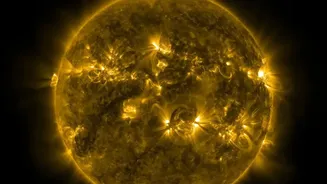
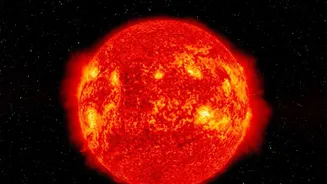
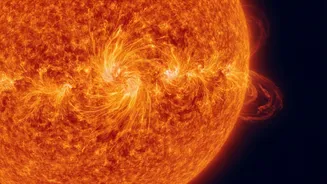
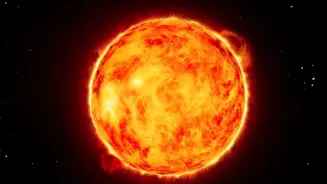
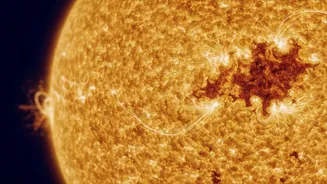
Using the world's largest solar telescope, astronomers have captured the most detailed images ever of the sun's visible surface, known as the photosphere. These unprecedented images revealed something startling: tiny, swirling plasma vortices breaking
like ocean waves at the edges of solar granules. These granules are massive cells of hot plasma, each one hundreds of kilometres across, that constantly bubble up from the sun's interior. The newly seen vortices are a phenomenon known as Kelvin-Helmholtz instability, which occurs when two fluids flow past each other at different speeds, creating a shear that develops into a spiral. Observing this on the sun at such a small scale is a monumental achievement, likened to spotting a detail on a coin from over 100 kilometres away.
The Technology Behind the Sighting
This groundbreaking observation was made possible by the National Science Foundation's Daniel K. Inouye Solar Telescope in Hawaii. By combining the telescope's high-resolution data with advanced computer simulations, researchers from institutions including the Max Planck Institute for Solar System Research were able to visualize these previously unseen processes. For decades, scientists have studied waves on the sun to understand its interior, much like geologists use seismic waves to study Earth's core. However, older telescopes could not capture images fast enough to detect certain types of waves. The Inouye telescope's power provides a new window into the sun's complex behaviour, confirming theories and opening up entirely new avenues of research.
Solving a Major Solar Mystery
The discovery of these tiny vortices could help solve one of the most enduring puzzles in solar physics: the coronal heating problem. The sun's outer atmosphere, the corona, is millions of degrees hotter than its surface, which is only around 5,500 degrees Celsius. This defies the basic laws of physics, as heat does not typically flow from a cooler object to a hotter one. Scientists have long theorized that magnetic waves, like the now-observed torsional Alfvén waves, could be transporting energy from the surface and releasing it in the corona. These newly spotted vortices are believed to be engines of magnetic energy, twisting and coiling magnetic field lines. This process builds up energy that can be released suddenly, potentially heating the corona and driving solar activity.
Impact on Earth and Space Weather
Understanding the sun's behaviour isn't just an academic exercise; it has profound practical implications for us on Earth. The sun drives space weather, releasing powerful bursts of energy and charged particles that form the solar wind. These solar events can disrupt our increasingly technology-dependent society. Powerful solar storms can damage satellites, interfere with GPS and communication signals, and even bring down power grids. By studying the fundamental processes that generate this activity, like the newly discovered plasma waves, scientists hope to improve their ability to predict space weather. This would give us crucial lead time to protect our vital infrastructure from the sun's powerful eruptions.