



A New Era of Cosmic Forensics
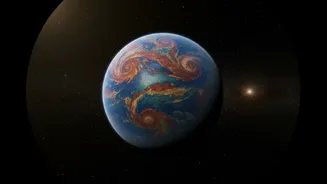
Humanity has now confirmed the existence of over 6,000 planets beyond our solar system, a number that grows by the week. For a long time, simply finding them was the goal. But we have entered a revolutionary new phase: characterisation. This is the science
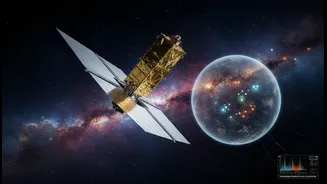
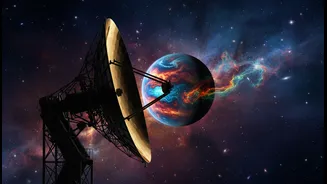
of not just knowing a planet is there, but knowing what it is like. At the forefront of this effort is the ability to study their atmospheres. Using a technique called transit spectroscopy, telescopes can analyse the faint light from a star as it filters through a planet's atmosphere during a transit. As different gas molecules absorb specific wavelengths of light, they leave behind a unique chemical fingerprint, a barcode that scientists can read from trillions of kilometres away. This allows them to identify gases like water, methane, and carbon dioxide, offering the first real clues about the climate and composition of these faraway worlds.
The Power of an Infrared Eye
The game-changer in this field is NASA's James Webb Space Telescope (JWST). While its predecessor, the Hubble Space Telescope, gave us our first tantalising glimpses, Webb's unparalleled sensitivity and focus on infrared light have opened a floodgate of data. Many of the most interesting molecules, including those essential for life as we know it, have strong signatures in the infrared spectrum. Webb can detect these with astonishing precision, turning faint signals into detailed atmospheric profiles. Recent discoveries from July 2026 showcase this power. On the hellish lava world 55 Cancri e, for instance, Webb found evidence of a dynamic atmosphere likely being vented from its molten rock interior. This kind of direct observation of a planet's geology influencing its atmosphere in real-time was science fiction just a few years ago.
A Gallery of Strange New Worlds
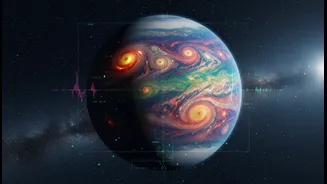
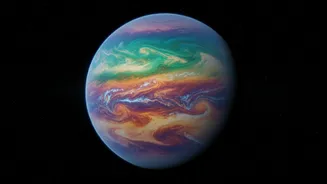
The results are painting a picture of a galaxy far more diverse and bizarre than we ever imagined. Take the 'super-puff' planet WASP-107b, a gas giant with an unusually large radius for its mass. Webb observations revealed its atmosphere is not only rich in water vapour but is also violently escaping into space. This dramatic atmospheric loss provides a live-action snapshot of how planets evolve when they are too close to their star's intense heat. In another recent breakthrough, astronomers used Webb to discover a new planet, Beta Pictoris d, not by seeing its faint light, but by spotting the distinct chemical signature of its atmosphere in the data. This novel technique could transform the search for planets that are otherwise lost in the glare of their parent stars.
Unraveling Unexpected Chemistry
Perhaps most exciting are the discoveries that challenge our assumptions. Telescopes are not just confirming the presence of expected chemicals; they are finding things that are hard to explain. On the ultra-hot Jupiter WASP-33b, astronomers detected the hydroxyl radical (OH), a highly reactive molecule that on Earth acts as an 'atmospheric detergent'. Its presence, likely formed from the destruction of water vapour at scorching temperatures over 2,500 degrees Celsius, offers a window into extreme atmospheric chemistry. On another world, K2-18b, Webb detected hints of dimethyl sulfide (DMS), a compound that, on Earth, is overwhelmingly produced by life. While this is far from a definitive proof of alien microbes, it highlights the telescopes' capacity to detect potential biosignatures—gases that could point toward biological processes.
The Search for Another Earth
Ultimately, the driving force behind much of this research is the search for habitable worlds. By studying the atmospheres of rocky planets in the 'habitable zone'—the region around a star where liquid water could exist—scientists hope to find a twin to our own planet. Recent studies of the super-Earth LHS 1140b have provided strong evidence that a rocky, habitable-zone planet can retain a significant atmosphere, a major milestone in this quest. However, scientists exercise extreme caution. Laboratory simulations show that many potential biosignatures, like oxygen and organic compounds, can be produced through non-biological photochemical processes. This means that any future claim of finding life will require exceptionally strong evidence and corroboration. We are not there yet, but for the first time in history, we have the tools to begin asking the question in earnest.