





The Unconquerable Fortress
Murud-Janjira's most compelling claim to fame is that it was never successfully conquered by a foreign power. Despite numerous, determined attacks from the Portuguese, the British, and even the formidable Marathas under Chhatrapati Shivaji Maharaj and Sambhaji
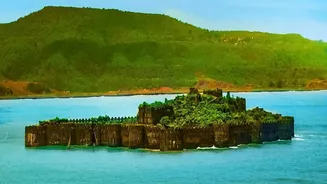
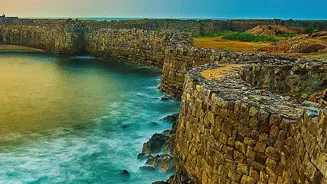
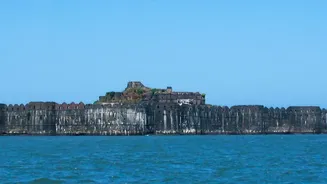
Maharaj, the fort’s defences never fell. Its location on an oval-shaped rock in the sea made it a uniquely challenging target. The main gate is cleverly concealed, only becoming visible at close range, a feature designed to thwart naval assaults. A sculpture near the entrance, showing a tiger-like beast overpowering six elephants, was meant to symbolize the strength and valour of its defenders.
A Marvel of Medieval Engineering
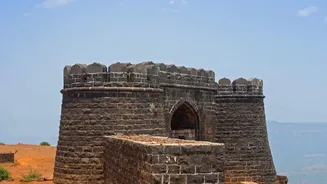
First built as a wooden structure in the 15th century by local Koli fishermen for protection against pirates, the fort was later reconstructed into a formidable stone bastion. This transformation is credited to Malik Ambar, a brilliant military leader of Abyssinian origin who served the Ahmadnagar Sultanate, around the year 1567. The fort's 40-foot-high walls are ringed by 19 imposing rounded bastions, which once held hundreds of cannons. Today, a few massive cannons, including the famed 'Kalaal Baangadi', remain as silent witnesses to its military past. Remarkably, the fort also contains the ruins of palaces, a mosque, and two large freshwater lakes, which provided a sustainable water source for its inhabitants despite being surrounded by the salty sea.
Stronghold of the Siddi Dynasty
For over three centuries, Murud-Janjira was the capital of the Siddis, a community of African descent who established themselves as powerful naval commanders. Originally serving the Nizam Shahi rulers of Ahmadnagar, the Siddis of Janjira eventually became independent rulers of their own princely state. Their control of the fort gave them command over crucial maritime trade routes along the Konkan coast. The fort was not just a military base but the seat of a dynasty that skillfully navigated the complex politics of the Deccan, forming alliances with powers like the Mughals to maintain their autonomy until India's independence in 1947.
From Fortress to Travel Landmark
After the Siddi state merged with India, the legendary fort slowly transitioned from a private stronghold to a treasured public landmark. Today, it stands as one of Maharashtra's most captivating tourist destinations, drawing visitors with its dramatic history and breathtaking views. The journey to the fort itself is part of the experience, with local sailboats ferrying visitors from the Rajapuri jetty to the island, just as they have for generations. Exploring its weathered ramparts, labyrinthine passages, and ruined structures offers a direct connection to a vibrant past. The fort no longer repels invaders but welcomes history buffs, photographers, and curious travellers, cementing its new place in the region's cultural and travel landscape.