

A Star’s Final Breath
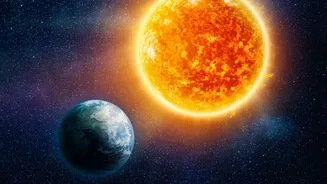
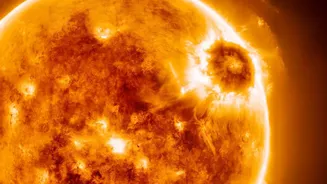
Every star, including our Sun, has a finite lifespan. In about five billion years, the Sun will exhaust the hydrogen fuel in its core. This will trigger a dramatic transformation. Without the outward push of nuclear fusion, the core will contract and
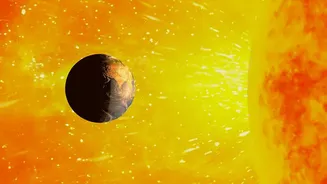
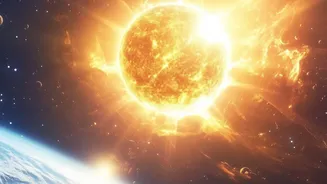
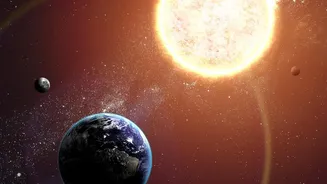
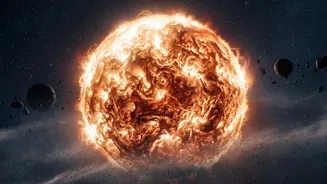
heat up, causing the Sun's outer layers to balloon outwards. It will swell into a red giant, a phase where it will become large enough to engulf the inner planets, Mercury and Venus. During this time, the Sun will also start to lose a significant portion of its mass—nearly half—shedding its outer layers into space before eventually collapsing into a dense, dim remnant known as a white dwarf.
The Old Theory: A Slow, Orderly Drift
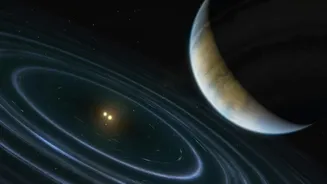
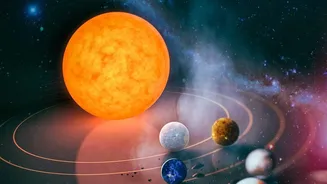
The long-held scientific consensus was that this mass loss would be a smooth, gradual process. As the Sun’s mass decreases, its gravitational pull on the remaining planets weakens. This would cause the orbits of the giant planets—Jupiter, Saturn, Uranus, and Neptune—to slowly and predictably expand. In this scenario, the outer solar system would simply become a larger, slower, but otherwise stable version of itself, surviving for trillions of years until a passing star might eventually disrupt it. It was a picture of a peaceful, long twilight.
New Evidence of a Chaotic End
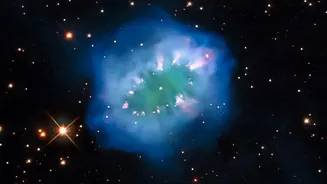
Recent research, however, paints a much more turbulent picture. A new study from astrophysicists at Caltech and the University of Michigan suggests the Sun's mass loss will be anything but smooth. Evidence from observations of other dying stars suggests they shed their mass not in a gentle stream, but in lopsided, uneven bursts. Each of these bursts gives the dying star a small 'kick' or shove. When applied to our own solar system, these repeated kicks would introduce a level of chaos previously unaccounted for.
How Bursts of Mass Create Instability
Imagine a spinning top that’s slowly losing its spin. Now imagine someone flicking it randomly from different directions. The top wouldn't just slow down; it would wobble and become unstable. This is what the new models suggest will happen to the Sun. Each asymmetric burst of gas will nudge the Sun, and that nudge will ripple through the gravitational fabric of the solar system, disturbing the orbits of the giant planets. Over hundreds or thousands of years, these small but persistent disturbances add up, dramatically altering the once-stable clockwork of the outer solar system. The gentle drift outward is replaced by a chaotic dance.
A New Fate for Our Giant Planets
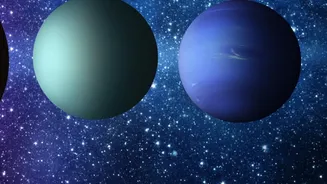
The consequences of this chaotic model are profound. The simulations show that in roughly nine out of ten scenarios, the orbits of the giant planets become unstable within a few billion years after the Sun becomes a white dwarf—a timescale astronomically shorter than the trillions of years previously predicted. Some simulations even showed Saturn being ejected from the solar system entirely, while others saw Uranus and Neptune swapping their orbital positions. Far from being a quiet end, the final stages of our solar system could be a period of dramatic upheaval, with planets careening into new paths or being flung into interstellar space. The machinery of our solar system, once thought to be eternally durable, might be broken by its own star.