


Meet NASA’s Interplanetary Detective
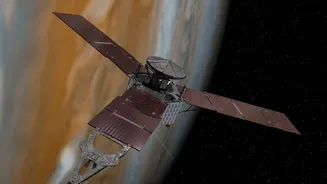
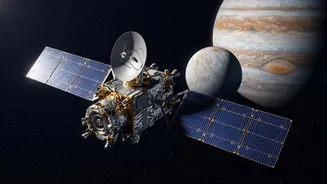
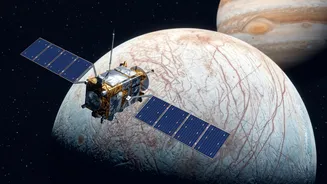
Launched in October 2024, NASA's Europa Clipper is a sophisticated robotic spacecraft on a multi-year journey to the Jupiter system. It is the largest interplanetary spacecraft ever built by the agency, with massive solar arrays spanning the length of
a basketball court to capture faint sunlight so far from home. Its primary goal isn't to find life itself, but to perform a detailed investigation of Europa to see if it has the right conditions to support it. After arriving in Jupiter's orbit in April 2030, the Clipper will begin a series of nearly 50 close flybys of Europa, dipping from high above down to just 25 kilometers from the surface to scan the moon in unprecedented detail.
Why the Fascination with Europa?
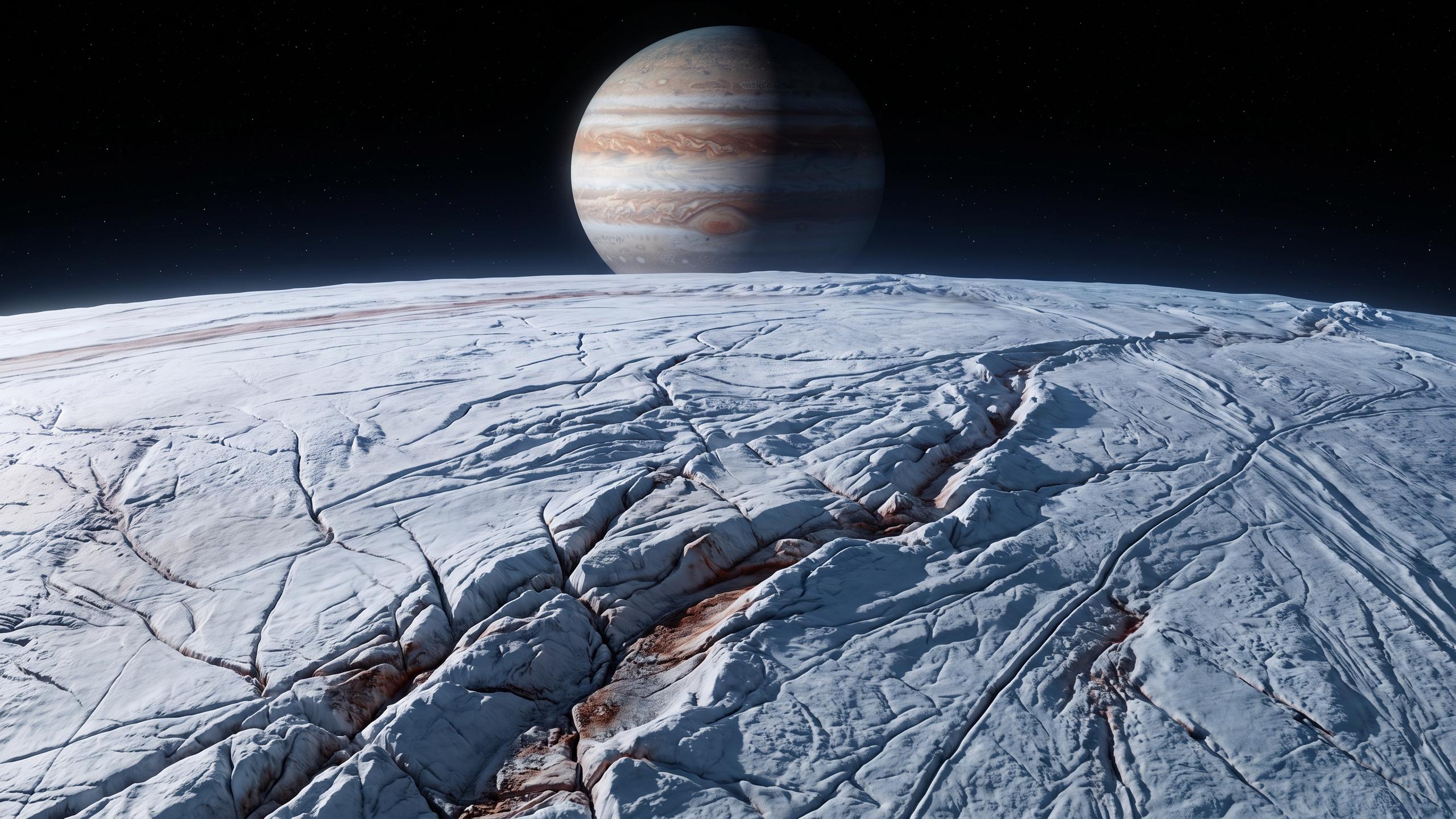
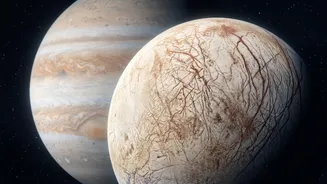
Europa has captivated scientists for decades. Evidence strongly suggests that beneath its kilometers-thick ice crust lies a global ocean of liquid saltwater, potentially containing more than twice the water of all of Earth's oceans combined. This massive ocean is kept from freezing solid not by the sun, but by internal heat generated from the constant gravitational tug-of-war between Jupiter and its other moons. This process, called tidal heating, could create an environment similar to Earth's deep-sea hydrothermal vents, which are teeming with life that thrives without sunlight. Life as we know it needs three key things: liquid water, essential chemical elements, and an energy source. Europa appears to have all three.
How to 'Taste' an Alien Ocean From Space
So how does Clipper analyze an ocean buried under a thick sheet of ice without landing? By looking for giant geysers. Evidence from the Hubble Space Telescope and NASA's Galileo spacecraft suggests that Europa may be venting plumes of water vapor from its ocean into space through cracks in its icy shell. Europa Clipper is designed to fly directly through these potential plumes. This would allow its instruments to directly sample the material erupting from the hidden ocean, essentially 'tasting' its chemical makeup without ever touching the ground. Even if the plumes are sporadic or non-existent, the spacecraft can still analyze particles kicked up from the surface by micrometeorite impacts, which could also contain traces of the ocean's chemistry.
The Scientific Toolkit for the Job
To accomplish this, Clipper is equipped with a powerful suite of nine science instruments. Two are particularly crucial for analyzing the ocean's ingredients. The SUrface Dust Analyzer (SUDA) is a mass spectrometer designed to scoop up tiny ice grains from the plumes or the surface and identify their composition. This will help scientists determine the ocean's salinity and search for key compounds. Another instrument, the MAss Spectrometer for Planetary EXploration (MASPEX), will analyze gases in Europa's extremely thin atmosphere and any plumes it encounters. Together, these tools will paint a detailed picture of the moon's chemistry.
Searching for the Recipe for Life
The Clipper is searching for what astrobiologists call the chemical building blocks of life. These are elements like carbon, hydrogen, nitrogen, oxygen, phosphorus, and sulfur (often abbreviated as CHNOPS). These elements, dissolved in the water and energized by chemical reactions, are fundamental to life as we understand it. By studying the composition of the surface ice and any plumes, scientists hope to determine if Europa's ocean is rich in these life-enabling chemicals. The mission will also use radar to measure the thickness of the ice shell and a magnetometer to confirm the ocean's existence and learn about its depth and saltiness. Finding these ingredients would not confirm the existence of life, but it would be a monumental discovery, suggesting that Europa is a potentially habitable world.