


The Moon's Mysterious Soil
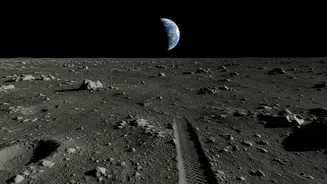
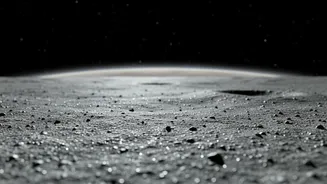
When we talk about lunar 'soil', scientists prefer the term 'regolith'. It isn't soft and earthy like soil on our planet. Instead, it's a complex mixture of shattered rock, tiny, jagged shards of glass, and dust created by billions of years of meteorite
impacts. This material covers the entire Moon, but the regolith at the poles is of special interest. Permanently shadowed regions in the south polar area are some of the coldest places in the solar system, with temperatures plummeting to nearly minus 250 degrees Celsius. These extreme conditions are considered ideal for preserving water ice for billions of years, making the polar regolith a prime target for scientific investigation and future resource exploration.
ISRO's Subsurface Probe
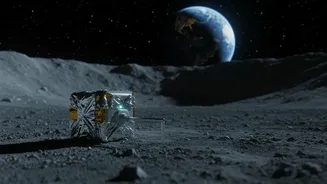
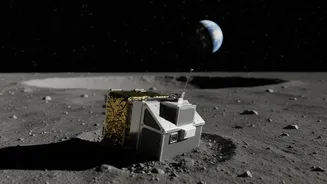
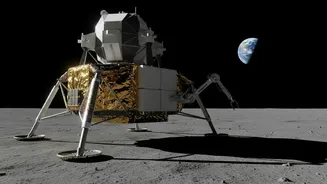
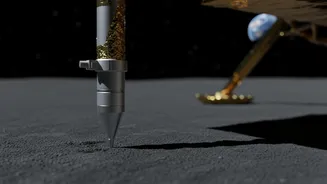
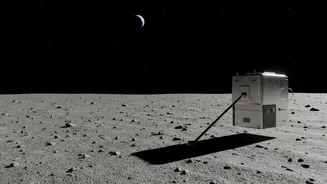
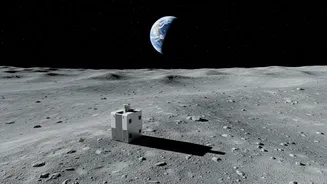
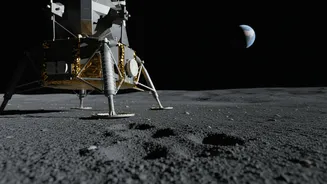
The Vikram lander from the Chandrayaan-3 mission, which successfully touched down near the lunar south pole in August 2023, carried a crucial instrument for this task: the Chandra’s Surface Thermophysical Experiment (ChaSTE). ChaSTE is a probe designed to penetrate the lunar surface and measure its temperature profile at different depths. Following its initial experiments, the lander performed a unique 'hop' manoeuvre, firing its engines to lift off and land again about 50 cm away. This action was not just a technological demonstration; it provided a golden opportunity for science. The engine blast blew away the top layer of loose dust, allowing ChaSTE to take a second set of measurements on this newly exposed, more compact material below.
A Surprising Layered Structure
The data sent back by ChaSTE revealed something unexpected. The Moon's surface isn't just a uniform pile of dust. The readings, particularly after the hop, suggested a distinct two-layer structure within the top few centimetres. The topmost layer, just 2-6 cm deep, is extremely porous and acts as a fantastic thermal blanket, showing much lower thermal conductivity than models predicted. This means it is incredibly effective at insulating whatever lies beneath it from the extreme temperature swings on the lunar surface. The analysis showed that while the surface could be around 50°C in the sun, the temperature dropped to -10°C just 8 cm below. This steep thermal gradient points to the exceptional insulating properties of this top layer of regolith.
Rewriting the Rules for Lunar Ice
This discovery of a highly insulating top layer is a game-changer for the search for water ice. Previously, scientists believed that for ice to remain stable, it would have to be in permanently shadowed craters where the sun never shines. However, the powerful insulating nature of the regolith, as measured by ChaSTE, suggests that water ice could be preserved much closer to the surface than previously thought, even in areas that receive some sunlight. The top layer of 'fluffy' regolith acts like a shield, protecting subsurface deposits from being vaporised by solar heat. This significantly expands the potential locations where future missions could find and access this critical resource.
The Impact on Future Missions
These findings have enormous implications for the future of lunar exploration. The ability to find and extract water is considered essential for establishing long-term human bases on the Moon, a concept known as In-Situ Resource Utilization (ISRU). Water can be split into hydrogen and oxygen to produce breathable air and rocket fuel, drastically reducing the cost and complexity of missions by not having to haul these resources from Earth. The data from Chandrayaan-3 provides a more accurate map of the thermal environment, helping mission planners select the best spots for future landings, drilling activities, and habitat construction. By revealing the layered and highly insulating nature of the polar regolith, ISRO has provided critical ground-truth data that will guide humanity's return to the Moon.