

Tackling the Data Deluge
Modern space science is a victim of its own success. Telescopes like the retired Kepler and the current TESS mission have gathered data on millions of stars, creating a bottleneck for human analysts. NASA's fleet of missions generates a torrent of information,
with archives holding over 150 petabytes of data. This is where machine learning becomes essential. AI algorithms can sift through these enormous datasets at speeds no human could match, identifying faint signals and complex patterns that might otherwise be missed. By training AI on what to look for, NASA can turn this data overload into a firehose of discovery.
The Automated Planet Hunter
One of the most exciting applications of AI is in the search for exoplanets—planets orbiting other stars. Manually verifying potential planets from telescope data is a slow, painstaking process. To solve this, NASA developed deep learning systems like ExoMiner. By training on verified data from the Kepler mission, ExoMiner learned to distinguish real planets from false positives, leading to the validation of hundreds of new exoplanets that had been previously overlooked in the data. This success has been expanded with ExoMiner++, which now analyzes data from the TESS mission as well. Other AI tools, like RAVEN, have also confirmed over 100 new worlds, including rare and extreme planets, by combing through TESS data.
Smarter, Safer Missions on Mars
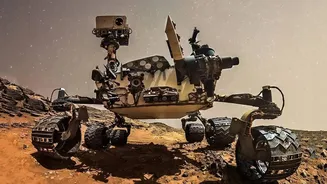
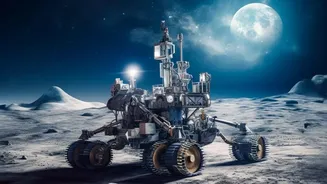
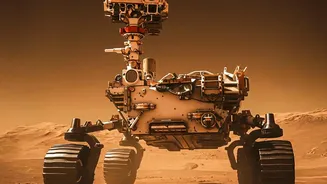
On the surface of Mars, AI is not just analyzing data; it's driving. NASA rovers like Curiosity and Perseverance use AI for autonomous navigation. Perseverance, for example, has performed the vast majority of its driving autonomously, using its cameras and onboard computer to identify hazards and plot safe routes across terrain no human has ever seen. In late 2025, the rover made history by traversing nearly 400 meters of Jezero Crater following a route entirely planned by an AI model named Claude. This capability is crucial, as the communication delay between Earth and Mars makes real-time human control impossible. AI also helps rovers decide which rock samples are scientifically interesting enough to analyze and send data back to Earth, optimizing precious mission time.
Predicting the Sun's Fury
Closer to home, AI is helping protect our technology from space weather. Solar flares and coronal mass ejections from the Sun can disrupt satellites, power grids, and GPS systems. Predicting these events has been a long-standing challenge. In partnership with companies like IBM, NASA has developed AI models like Surya. Trained on years of solar images from the Solar Dynamics Observatory, Surya can analyze the Sun's activity and provide earlier warnings of potentially disruptive solar events. Another model, called DAGGER, analyzes solar wind measurements to predict where a solar storm will strike on Earth with a 30-minute advance warning, giving operators time to protect critical infrastructure.
A New Partner in Discovery
Across the agency, AI is becoming an indispensable partner. It helps automate mission planning and scheduling, monitors spacecraft health to predict system failures, and even aids in tracking orbital debris to protect satellites. NASA's broader AI initiatives, like the Genesis Mission and the Frontier Development Lab, aim to integrate machine learning even more deeply into future missions. This isn't about replacing human scientists but augmenting their abilities. AI handles the heavy lifting of data processing, freeing up researchers to focus on interpretation, hypothesis, and the next big questions. The goal is a seamless collaboration between human and machine intelligence, accelerating the pace of exploration and our understanding of the universe.