

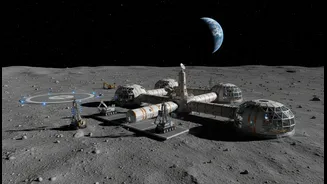
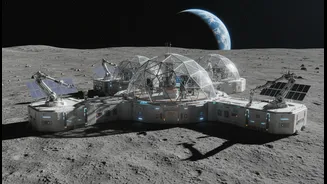


A New Era: From Visiting to Staying
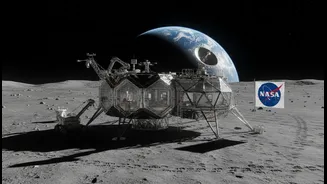
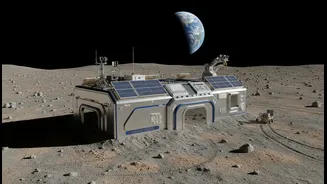
The Apollo missions of the 1960s and '70s were historic sprints—quick trips to plant a flag, collect rocks, and prove it could be done. NASA's current Artemis program has a fundamentally different goal: not just to visit the Moon, but to stay. This shift
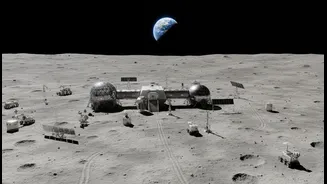
from temporary expeditions to establishing a sustained human presence requires a new way of thinking. Instead of packing everything needed for the entire trip, the strategy is to find a location that can provide resources locally. This concept, known as in-situ resource utilization (ISRU), is the driving force behind the choice of the lunar south pole. It’s a pragmatic decision that turns the Moon from a destination into a stepping stone for deeper space exploration.
The Lure of Eternal Shadows
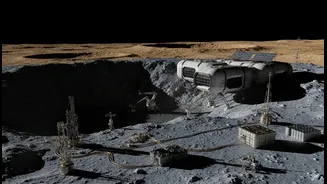
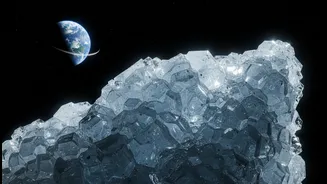
The geography of the lunar south pole is unlike anywhere else. Due to the Moon's slight axial tilt, the sun's rays skim the surface at a very low angle. This creates a landscape of extreme contrasts. While some crater rims and peaks are bathed in near-constant sunlight, perfect for solar power generation, the deep floors of some craters have not seen sunlight in billions of years. These aptly named "permanently shadowed regions" (PSRs) are incredibly cold, with temperatures plummeting to as low as -203°C. These natural cold traps are crucial because they are believed to have preserved volatile materials, chiefly water ice, that would have otherwise been vaporized by solar radiation.
Water: The Moon's Liquid Gold
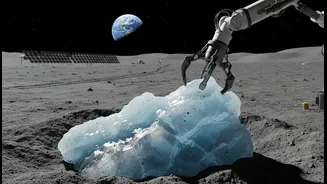
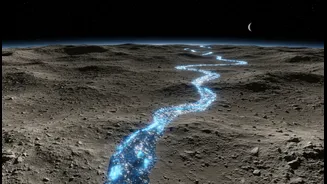
The most significant resource suspected to be trapped in these shadowy craters is water ice. The prohibitive cost of launching materials from Earth makes finding local water a game-changer. Its utility is threefold. First, it can be purified to provide drinking water for astronauts and to grow plants. Second, water (H2O) can be split through electrolysis into its component parts: hydrogen and oxygen. The oxygen can be used to create breathable air for the habitat. Third, and perhaps most transformative, liquid oxygen and liquid hydrogen are the primary components of powerful rocket propellant.
A Gas Station on the Way to Mars
The ability to manufacture rocket fuel on the Moon is the core of the utility angle. Launching fuel from Earth is incredibly expensive because you have to use fuel to lift more fuel. By mining lunar ice and processing it into propellant, the Moon base effectively becomes a refueling station in space. Spacecraft could launch from Earth with only enough fuel to get to the Moon, refuel there, and then continue to more distant destinations like Mars with a much larger payload. This ISRU-based approach dramatically reduces the logistical and financial burden of deep space exploration, making ambitious long-duration missions more feasible.
More Than Just Water and Sunlight
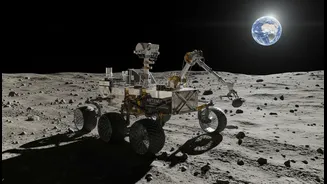
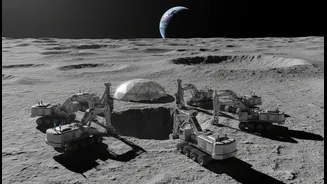
While water ice and constant sunlight are the main attractions, the lunar south pole offers more. The lunar regolith (soil) is rich in oxygen, which can be extracted from minerals even outside the shadowed craters. There is also scientific interest in other potential resources, such as helium-3, which could be a fuel source for future nuclear fusion reactors, and various metals that could be used for on-site manufacturing and construction. Utilizing these local materials for 3D printing and building structures further reduces the reliance on Earth. This makes the base more self-sufficient and resilient, moving from a temporary outpost to a true settlement.