



Cosmic Hide-and-Seek
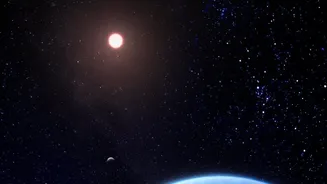
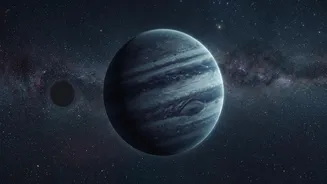
For seven years, astronomers using NASA's Transiting Exoplanet Survey Satellite (TESS) watched TOI-2535 b like clockwork. This 'hot Jupiter'—a gas giant orbiting perilously close to its star—would regularly pass in front of it, causing a tiny, predictable
dip in the star's light. This is the transit method, our most successful tool for finding new worlds. Then, in March 2026, the dips stopped. The planet, from our perspective, had seemingly gone missing. This wasn't a case of a planet being destroyed, but something far more interesting: its orbit had changed.
The Unsteady Clock
Even before it 'vanished', TOI-2535 b was acting strangely. A planet in a solitary orbit should transit with metronomic regularity. Yet, TOI-2535 b was a wobbly timekeeper. Its transits would sometimes arrive up to six hours early, and at other times, six hours late. This phenomenon, known as Transit Timing Variation (TTV), is a huge red flag for astronomers. It screams that something else is out there, gravitationally meddling with the planet's orbit. Think of it like a perfectly spinning top that starts to wobble; it's almost always because an external force is acting on it.
The Hidden Hand of Gravity
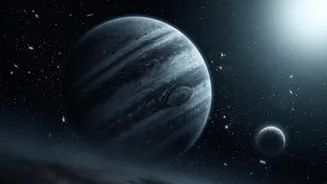
The culprit behind TOI-2535 b's erratic behaviour is a hidden neighbour. Scientists have deduced the presence of at least one other massive planet in the system. The constant gravitational tug-of-war between these two giants causes both of their orbits to wobble, or 'precess'. For seven years, TOI-2535 b’s orbit was aligned just right for us to see it cross its star. But this relentless gravitational dance eventually tilted its orbit just enough that, from our viewpoint on Earth, it no longer passes in front of its star at all. The planet is still there, just hidden from our transit-based view.
A Feature, Not a Bug
What makes the TOI-2535 b story so compelling is that it perfectly illustrates how TTVs are a powerful discovery tool. An irregular transit isn't a failed observation; it's a clue. By precisely measuring how early or late a planet is, astronomers can work backwards. They can calculate the mass and orbit of the unseen body that must be causing the disturbance. This method has been used to find 'invisible' planets that do not transit their star at all. Kepler-19c, for instance, was the first world discovered solely through the gravitational influence it had on its transiting sibling planet. The 'missing' planet, therefore, becomes a signpost pointing to another, otherwise hidden world.
A New Chapter in Planet Hunting
TOI-2535 b is the first confirmed case of a planet orbiting a single star being observed to cease transiting entirely due to these dynamic interactions. It provides a rare, real-time glimpse into how planetary systems are not static, clockwork mechanisms, but are constantly evolving. While we won't see TOI-2535 b transit again for another 30 to 50 years, the data from its disappearance has already revealed the existence of its companion. It's a reminder that in the vastness of space, what appears to be a flaw in the data is often the beginning of a new discovery.