




Our Restless Star and its Rhythms
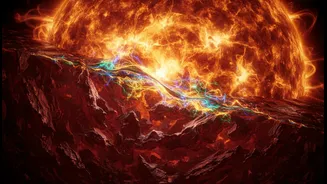
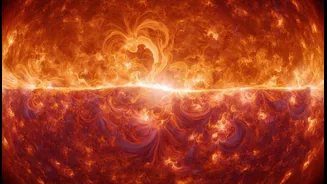
Our Sun is not the perfectly steady ball of fire it might seem. It operates on an approximately 11-year cycle, swinging between periods of quiet (solar minimum) and intense magnetic activity (solar maximum). During a maximum, the Sun's surface is peppered
with sunspots, and it's more likely to unleash powerful solar flares and coronal mass ejections. These solar outbursts can have significant effects on Earth, disrupting radio communications, damaging satellites, and even threatening electrical power grids. For our technology-reliant society, predicting the timing and strength of these cycles is a major scientific challenge. For decades, scientists have struggled to create reliable forecasts, with many predictions for past cycles proving inaccurate. This difficulty stems from the fact that the engine driving the whole process lies deep within the Sun, hidden from direct view.
A Mysterious Boundary Layer
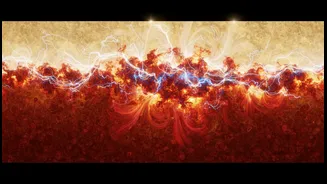
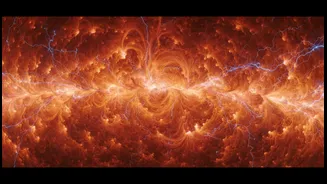
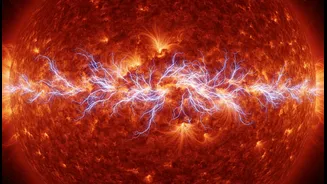
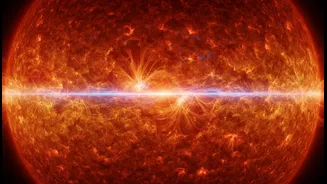
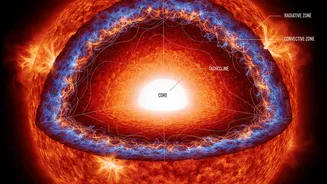
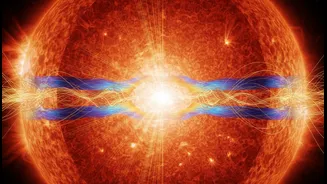
Enter the tachocline. First proposed in 1992, the tachocline is a surprisingly thin layer located about 200,000 kilometres below the Sun’s surface. It acts as a crucial interface, separating two distinct zones of the solar interior. Below it lies the radiative zone, a vast region where energy slowly radiates outward and which rotates like a solid, rigid ball. Above it is the convection zone, a turbulent, boiling sea of hot plasma that makes up the outer 30% of the Sun. In this outer zone, the rotation is differential, meaning the equator spins faster than the poles. The tachocline is the shear layer where these two dramatically different rotation styles meet. This creates immense mechanical stress and is believed to be the primary region where the Sun’s powerful magnetic fields are generated.
The Engine of the Solar Dynamo
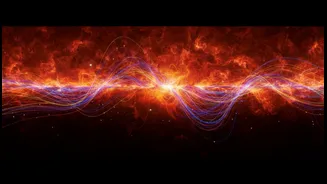
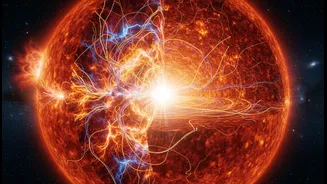
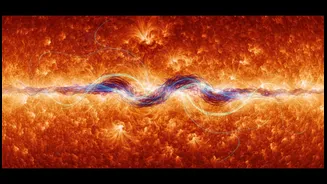
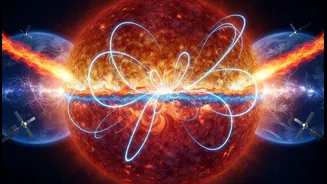
Many physicists believe the tachocline is the heart of the solar dynamo—the physical process that converts the kinetic energy of the Sun's moving plasma into magnetic energy. According to dynamo theory, the immense shear in the tachocline stretches and amplifies weak, north-south oriented (poloidal) magnetic fields, twisting them into powerful, east-west oriented (toroidal) magnetic bands. These toroidal fields, once they become strong enough, can become buoyant and rise through the convection zone to the surface, creating the sunspot pairs we observe. Over the course of the cycle, this process eventually leads to the Sun's entire magnetic field flipping its polarity, paving the way for the next cycle to begin. By understanding the precise dynamics of the tachocline, researchers hope to better model this fundamental process of field generation.
The Modeling and Mystery Challenge
So, if the tachocline is so important, why haven't we solved the solar cycle puzzle? The headline's caution against “solved-solar-mystery claims” is well-founded. The tachocline itself is a profound puzzle; scientists are still debating the precise mechanisms that keep it so remarkably thin. Furthermore, we cannot observe it directly and must rely on helioseismology—the study of sound waves reverberating through the Sun—to infer its properties. While dynamo models incorporating the tachocline are improving, they are incredibly complex and must make assumptions about conditions deep inside a star. Adding another layer of complexity, recent observations of some stars that are fully convective (and thus lack a tachocline) show they still generate strong magnetic fields and activity, suggesting the dynamo process might be more versatile than previously thought.
A Path Forward, Not a Silver Bullet
Incorporating a more detailed understanding of the tachocline is undeniably a key to improving solar cycle models. It's where the fundamental action of the dynamo is thought to occur. As simulations become more powerful and our observational data improves, models will get better at representing its role. However, it is not a silver bullet. Progress in this field is incremental. Scientists are also focusing on other crucial factors, such as the strength of the Sun's polar magnetic fields at solar minimum and variations in the flow of plasma within the convection zone, known as meridional circulation. New approaches, including AI and machine learning, are also being tested to find patterns in the vast amounts of solar data we've collected.